 Skip to main content


Controlling Pests With Birds
Birds provide valuable ecosystem services, defending crops, such as grapes and coffee, from insects.

Bird-minded conservationists tend to focus on what the environment can do for their feathered friends. In a unique reversal, Julie Jedlicka decided to look at what birds can do for their environment. The University of California-Berkeley researcher calls it economic ornithology, asking, “What are the ecosystem services birds can provide?” She took to the vast vineyards of nearby Sonoma to find out.
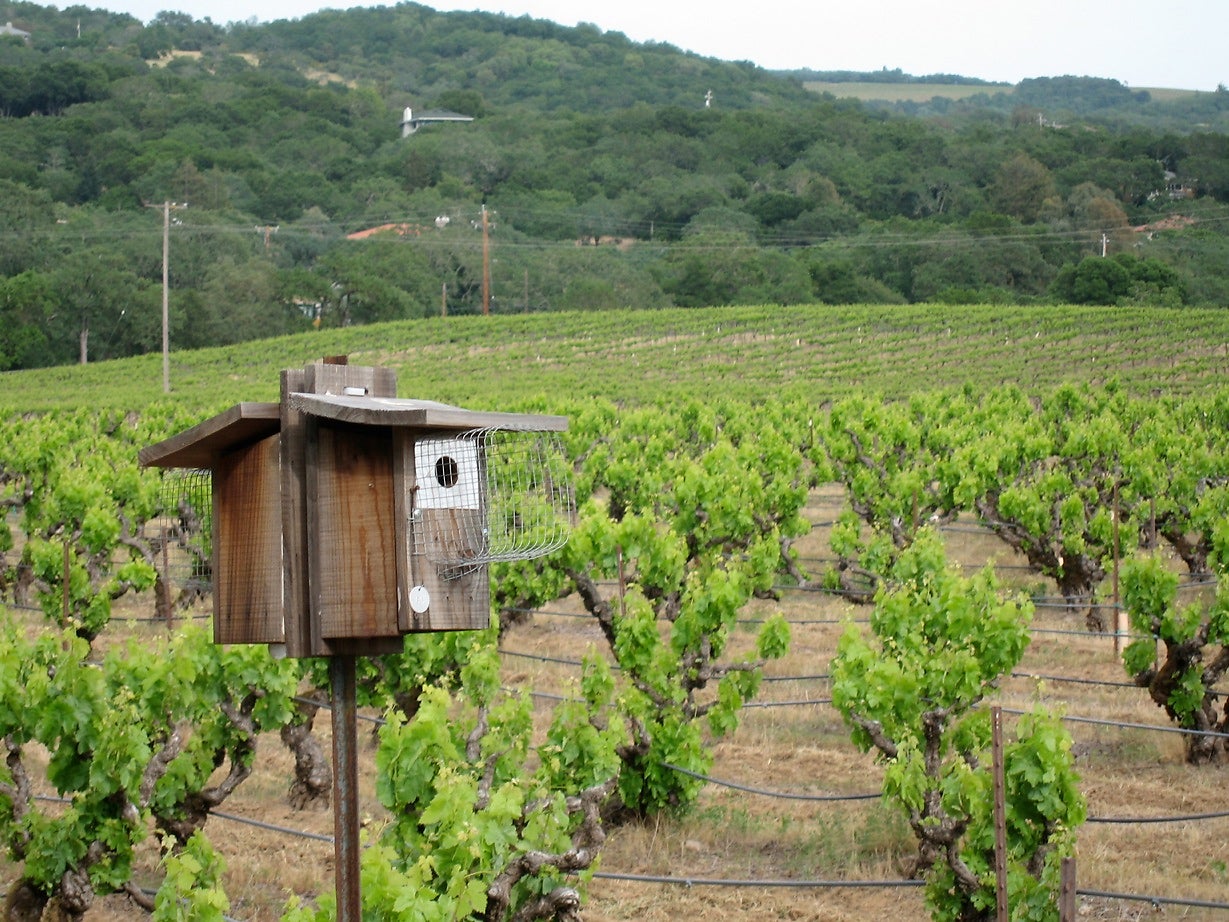
Her team put up more than 200 western bluebird boxes (like the one below) among the grapes, then mimicked an outbreak of beet armyworm—a pest partial to vineyards—by pinning larvae to cardboard. Some of these insect posters went directly below nest boxes; others were placed sporadically around the vineyards. “Not surprisingly, we found that in areas with nest boxes, significantly more larvae were removed than in areas without,” she says. “That number went up even higher if we were directly below a nest box.” The bluebirds were inadvertent crop defenders, fending off insect damage simply by eating lunch.
Others are also looking at birds as natural pest controllers. For years Matt Johnson, a Humboldt State University wildlife habitat ecologist, has studied birds’ benefits to coffee, specifically in relation to the coffee berry borer in Jamaica. (Females force their way into coffee berries, hollow them out, and lay eggs inside.) His team placed netlike tents over coffee bushes to keep birds out and normal insect populations in. “The damage was much higher inside the exclosures than outside,” he says. Johnson went one step further, calculating the dollar value to coffee farmers—from $16 to $120 per acre—of having the right bird species around.
Johnson and Jedlicka say birds can be part of a comprehensive insect-management plan. That can motivate farmers to better conserve their land—in turn creating better bird habitat—and perhaps even someday help them earn a “bird-friendly” label. Russell Greenberg, who runs the Smithsonian Migratory Bird Center, spells out just how important avian species are. “There are always potential pests out there that are kept in check,” he says. “You never know what’s going to happen if birds are gone.”
This story originally ran in the March-April 2012 issue as, "Pest Control."