 Skip to main content


Parrot Conservation Changes a Catholic Tradition
Fifteen years ago the yellow-eared parrot was presumed extinct. Its rediscovery in Colombia forced the Catholic Church to abandon an age-old tradition, and brought about one of the most amazing comebacks in the Americas.

It doesn’t look promising. They come every evening, we’ve been told. As sure as sunset. You can practically set your clock by them . . . though there are always exceptions.
A wise caveat, as sunset is upon us and the only creature in sight is a black-billed mountain toucan noisily shelling seeds in a broadleaf evergreen tree. What’s more, as the thin mountain light fades, practical matters loom. Having slithered a mile down a steep Andean clearing to reach this spot, we’ll soon be scrambling back up in the dark. We are six—the driver, three biologists from the Colombian nonprofit ProAves, the Ecuadoran photojournalist Pablo Corral Vega, and me. Between us we can muster a headlamp and two cell phones with which to light our way back to the jeep. It’s pointless to wait. They’re not coming. We should go.
And yet we linger. The evening’s magic has transformed this uneven, boggy clearing. The stillness. The green-scented mountain air. The ghostly ivory columns of the two wax palms towering above the ragged pasture and shreds of forest.
“Perhaps they are arriving on the bus of six o’clock,” Corral murmurs dreamily.
A querulous squawk answers him. Six human heads snap to attention.
Straggling in from the east like a squadron of bombers returning late to the airfield just as all hope fades in the heart of the ingénue, our long-awaited aviators spike the far sky. We know them by their quizzical, parroty cawing long before their bulldog heads and scimitar tails wing into focus. The birds sweep round our tiny valley in a victory lap, then swoop straight at the crowns of the palms. Inches from crash-landing, each bird fans its flight feathers hard and drops to the woody backbone of a frond. Within minutes hundreds of green parrots stud the branches, their fluffy yellow muttonchop whiskers and mustaches barely discernible in this light. “They are enchanting, these moments in the dormitory trees,” says biologist José Castaño.
Indeed, these are gregarious parrots. They chortle and chuckle. They squabble. They burble sweet nothings, cheek-to-cheek. Vie for position. Nibble at the panicles of strawberry-sized palm nuts—more diversion than sustenance, Castaño says. There’s a little grooming, much preening, what looks like the feeding of fledglings—one’s beak poked down into another’s, with telltale chuffing sounds—and some impressive displays of one-legged dangling.
As the hour advances, trios and quartets of the birds perform Chaplinesque sidestepping routines, tottering down the tops of the long, arching branches to nestle in the gloom of the palm crowns. Gradually more and more birds sidle into the darkness. Soon the two trees look as uninhabited as they did half an hour ago, with only a sleepy burble or two to give the game away.
The chance to observe Ognorhynchus icterotis, the yellow-eared parrot, is well worth scrambling home in the dark. It’s among the world’s most endangered psittacidae, says the Australian ornithologist Paul Salaman, and one of the most specialized. Endemic to these high, cloudforested flanks of the northern Andes, the yellow-eared parrot is the sole species of a single genus, and dependent for its survival in Colombia on this one species of endemic wax palm, Ceroxylon quindiense. The parrots will nest in no other tree here. In the absence of quindío palms with commodious cavities, they forgo nesting. They die out.
The immediate threat to this bird is unique, too: the observance, by tens of thousands of adherents to the Roman Catholic Church, of a beloved annual tradition, Domingo de Ramos. Palm Sunday, the Sunday preceding Easter.
“On this first day of Holy Week we celebrate Jesus’ entrance into Jerusalem, in His maximum humility, astride a donkey,” says Father Angel José Pareja Garcia, new pastor of Jardín, home of these parrots. “It is said that people along His path saluted him with boughs and hailed Him Cristo Rey. In the processions, we reenact Jesus’ ride into Jerusalem. For this we use the palms.”
Therein lies the crux of the matter. The parrots require the tree; the church requires its palms.
“We have used this palm for 1,000 years,” Pastor Raúl Ortiz pronounced when the yellow-eared parrot was discovered in his parish, late in 1999. “It is God’s will that we use it. He will never let the wax palm run out.”
More than a century ago naturalists knew of large populations of yellow-eared parrots in Colombia and Ecuador, tens of thousands of the birds, likely living everywhere the quindío palm (and in Ecuador a closely related wax palm) was found. The birds’ unique brand of habitat was a broad swath of the central and oriental cordilleras of the Andes, in cloudforests at elevations between 6,000 and 9,000 feet. Altitude proved no sanctuary. European settlement brought deforestation, and hunters and weekend warriors would shoot everything that moved—including Ognorhynchus and the mountain tapirs, curious long-snouted herbivores that ingest and disseminate wax palm nuts.
By 1996 the species was presumed extinct. That year a flock of 30 yellow-eared parrots popped up in Ecuador, but by 1997 they had vanished. No one knows why.
Enter Salaman, a hotshot young birding guide leading 15 intrepid life-listers on a high-speed traverse of Colombia. One day a raucous flock of yellow-mustachioed birds flapped by. Salaman posted the unexpected sighting on a birding listserve. Within 18 months, with funding from Spain’s Loro Parque Foundation, a young Argentinean ornithologist was ensconced at a field station near the farming town of Roncesvalles, in Tolima state, monitoring the newly discovered population of 61 birds.
To his surprise he found that the Ognorhynchus were barely nesting. They can’t cut through palm trunks on their own, he discovered. The parrots have to find a palm with a woodpecker hole, or a dead palm decapitated by a storm, exposing the pith at the headless neck, down through which the birds can scoop a cavity. (With a green-and-yellow tuft of parrots perched at the opening, these headless palms have a charming look of misproportioned feather dusters.)
Unfortunately, Roncesvalles had long ago been stripped of cloudforest, and woodpeckers with it. The wax palms survived in pastures, tolerated because dead palms yield excellent fence posts—easily split and naturally water-resistant. Hence palms but few nests. Out of 30 possible pairs, only one nested; a single precious chick hatched.
The conservationists launched an awareness campaign: These birds are something to be proud of, the last of their kind in the world. You can help them. “People responded,” Salaman says. They stopped taking potshots at the parrots. The sympathetic local priest counseled his human flock to protect wax palms. And the avian flock began to prosper.
Nonetheless, one small flock does not a recovered species make; it’s too easily annihilated by a storm or a virus or an artillery battle between government and guerrilla forces (as happened twice in Roncesvalles, mercifully with no lasting harm to the parrots). The ornithologists kept looking.
Three years later a sharp-eyed state forester in Jardín, 100 miles north of Roncesvalles in Antioquia state, heard squawking overhead and glimpsed something remarkably Ognorhynchus-like. Plunging headlong after it, the forester found 22 yellow-eared parrots merrily stripping fruit from a tree. The Roncesvalles team confirmed the find. And a young bird enthusiast began the search for dormitory sites—an epic task here where cloudforest was still extensive and wax palms, once the dominant tree, mysteriously scarce.
On a Sunday in April three months later, the mystery of the missing palms was solved. From a balcony overlooking the plaza in Jardín, José Castaño, Salaman, and others watched as hundreds of joyous celebrants streamed behind Pastor Raúl toward the church, each rattling a segment of a quindío wax palm spear.
“The calculations were whizzing through our heads,” Salaman says. “There were enough branches down there to account for what—200, 300 wax palms? Trees that don’t even flower till they’re 25 years old. Protecting these parrots was going to be nothing like Roncesvalles. We would have to attack this problem in a completely different way.”
In fact they’ve used “just about every tool in the kit,” says Salaman, and in working to save Ognorhynchus have improved the prospects for all of this region’s birds.
“First we thought, well, we’ll ask the pastor for his support,” Castaño says. It had worked in Roncesvalles. Padre Raúl, however, was an autocrat of the old school. “It is God’s wish that the palm of Palm Sunday be wax palm,” he pronounced.
Then a forestry lawyer unearthed a wonderful fact: In 1985 Colombia had designated Ceroxylon quindiense its national tree. Chopping down a quindío wax palm, it turned out, is a federal offense. The conservationists had the law on their side. But what constituted their side, exactly? A clutch of ardent ornithologists, birders, and students without portfolio.
“You have to do these things properly,” Salaman says. “Build an organization, not just something you run out of your own bank account. So we got together near the end of the year in 1999, wrote some bylaws and a constitution, and kicked the thing off.”
“Oh! We were full of dreams and plans,” says Castaño, one of the first secretaries of the newly hatched ProAves, Colombia’s first national bird conservation organization and a BirdLife International collaborator. The founders (Castaño, Salaman, and eight others) started meeting landowners, monitoring the birds’ behavior, and instituting a public awareness campaign and a school program. The forestry lawyer sent an official letter hinting of repercussions if the church allowed use of the palms.
Padre Raúl, the town’s priest, blew a gasket. Fulminating from the pulpit, he admonished parishioners to stand fast and keep using the palms, insisting that these were not the wax palm and it was a lie that the parrots nested in them.
“It became our propaganda against their propaganda,” Castaño says ruefully.
On Palm Sunday 2002, ProAves distributed balloons and all manner of branches in the square. The forestry police reluctantly confiscated quindío boughs before people joined the processional, and fined their bearers.
“Oof, it was ugly,” Castaño recalls with a shudder.
Jardín lies in a verdant hanging valley 5,000 feet up in the western cordillera. Its inhabitants are known for their industriousness, reflected everywhere in tidy farms, glossy horses, and glorious flower boxes. Coffee is the staple crop. Higher up, farmers clear the cloudforest for grazing, creating near-vertical pastures that cattle trample into corduroy. In heavy rains these wales become fracture lines along which the soil subsides in great earthen scallops.
Intact forest can slide, too, and mud, shattered trees, and rainy-season erratics—fallen boulders the size of Barca-loungers—choke the vertiginous dirt “highway” that zigzags up the cloud-sodden ridges to the parrots’ dormitories, pushing the jeep so close to cliff’s edge that in a couple of spots this lily-livered journalist opted to walk.
Still, the road isn’t half as scary as it used to be.
“You know that in Colombia in the past we’ve had problems with guerrillas,” Castaño says delicately. His colleagues collapse in laughter. Castaño relents. “Okay. The immediate past.” For decades this route, a key corridor for FARC guerrillas, was iffy in daylight, dangerous at night. Landowners stayed in town, paying the protection money known as vacuna—vaccine—to right-wing paramilitaries and guerrillas. Late in 2001 guerrillas kidnapped a young Dutch Ognorhynchus researcher and held him for eight terrifying months.
In 2002 presidential candidate Álvaro Uribe rode a hard-line anti-guerrilla platform into power and threw the country’s resources into a controversial war against guerrillas and the drug cartels. This area became safer, but at the expense of other government programs. Paradoxically, that provided an opportunity for habitat conservation, says Felipe Barrera, Ognorhynchus project director.
“Uribe pushed municipalities to become more autonomous, to pay their own health or education or road maintenance costs,” Barrera says. “Municipios must prioritize. Jardín has reforestation goals it can’t meet. So ProAves’ activities offered a big advantage.”
The ProAves team began collecting and germinating seeds of fruit trees eaten by the parrots. Castaño worked with landowners to incorporate these into living fences, shade canopies, and stream buffers, particularly in the coffee zone, where native vegetation is rich with birdlife both resident and migratory. “That open, broken canopy where the parrots go down to feed happens to be the key area for wintering cerulean warblers,” Salaman says, “the fastest-declining North American songbird.” Collaboration with the local coffee cooperative and the American Bird Conservancy produced a bird-friendly specialty coffee and yielded the country’s first conservation easement.
Not all the landowners care about conservation, Castaño says, “but people were sick of the violence and fear of the last 40 years.” People were open to new approaches.
In the end, perhaps in acknowledgment of the changing times, it was the church itself that broke the deadlock. Padre Raúl was transferred. His successor was Padre Mario Agudelo, Jardín born and bred. “God doesn’t care what branches we use,” Padre Mario announced to the ProAves staff in 2003. “Bring us some options.” Padre Mario chose bamboo. It was not a success.
“Trash,” says Adela Marulanda bitterly. “That bamboo was trash.”
Doña Adela, a widowed resident of Jardín, devotes herself to church decorations. “I do something different every time,” she says. “Arranging flowers. Draping the altars with cloths. Of course, for Palm Sunday we would arrange palm branches everywhere. Oh, they were magnificent.” The sour-lemon look returns. “Bamboo! People still have a bad taste about it.”
It was traditional to save the palms after the priest had blessed them, Doña Adela says. “You would tuck the palm behind your door and if a storm was coming, you would burn a leaf on the patio, reciting three credos. With the ash you would draw three crosses on the ground. And the storm clouds would move away!”
Doña Adela paces through the ritual, stepping out to the covered front gate, miming the burning, the ash, the crosses, the credos. As she speaks, the afternoon sky darkens to a bilious purple.
“With bamboo, what happened? The first day it was green, the second day the leaves all dried up and fell off. Pfff! Now it was like a plain broomstick. What good is that?”
A clap of thunder punctuates her sermon and the heavens let loose, rain pouring down in torrents, trapping pedestrians who plaster themselves helplessly up against the buildings. A sheet of water sluices down the cobblestone street. The rare umbrella inverts itself in a tremendous gust of wind. Satisfied, Doña Adela purses her lips then raises her voice as lightning explodes over the town. “I tell them it’s not the wax palm and it’s not going to run out! But they don’t listen!”
Jardín’s Catholic church—a 1920s Gothic stone monolith—occupies a broad dais at the head of the town square. You can see its shiny steeples from just about everywhere in town, since the street grid around the square is only a few blocks deep and no other building is higher than two stories. People walk to the market, to school, to the hairdresser, to the bank, or hire a three-wheeler taxi. The milkman rides a handsome strawberry roan, hooves clattering on the cobblestones, strings of plastic milk jugs looped over the saddle horn.
The square itself is a leafy, magical place, as lively as a yellow-eared parrot roost at sunset. People sit outside at little wooden tables tended by owners of the storefront cafes, from which float melodies—Mexican pop or tango. Families occupy a few tables, a quintet of matrons another; clusters of high school students giggle and flirt on benches under the trees.
At a table flaking pink paint, two brothers, lean, handsome men in their 60s, nurse demitasses of tinto, the instant coffee that is the inexplicable favorite of Colombians. “Yes, we used to carry wax palms on Domingo de Ramos, but we don’t anymore,” the younger, Mario, confides genially. “Because the yellow-eared parrot makes his little nest in the tree and in no other. So now we use a different branch. It’s not as good against storms, though.”
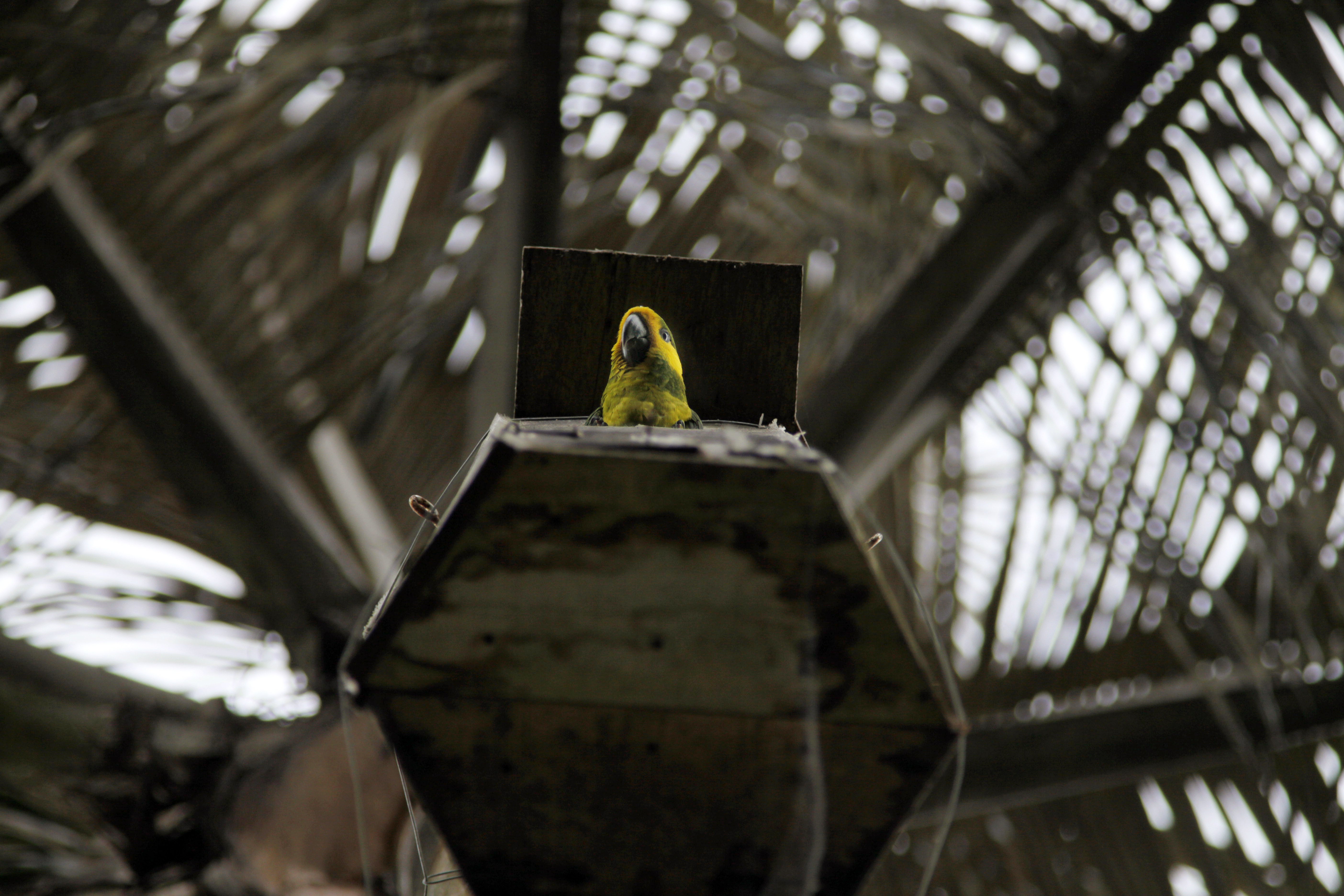
Two blocks east lies the small house that serves ProAves as headquarters and the youth of Jardín as an informal clubhouse. The dozen gray pulpits standing about the utilitarian courtyard are artificial nest boxes, soon to be attached to wax palms in the cloudforest. Initially skeptical, the parrots now accept the boxes; close to 50 young have fledged from them.
It’s Palm Sunday minus one—Saturday, that is—and Ana Velasquez, ProAves’ education coordinator in Jardín, is distributing paintbrushes to kids. The churchwomen’s group has invited them to carry a banner in the procession tomorrow. “La Vida es Sagrada. Reconciliate con la naturaleza,” they paint. Life is sacred. Reconcile yourself with nature.
And so the day dawns. The ProAves kids are doing a brisk business in the square selling iraka. Native, common, and abundant, it has been the sanctioned frond since bamboo was ditched in 2004. People are pouring in from the countryside—on horseback, squeezed onto motorcycles, packed into coffee-cooperative jeeps. The forestry police staked out the roads before dawn, looking for wax palms coming into town. Every year there have been fewer. This morning there are none.
The great church hall has been decorated with upright iraka—fanned open to show the lovely shading from the green outer leaves to the creamy yellow innermost. “The iraka are puny,” grumbles Doña Adela, still officially opposed to the change. “But pretty,” she adds grudgingly. She softens. “Yes, I was very pleased at how the hall turned out.”
“Sometimes people feel so daunted,” Paul Salaman says. “It’s so difficult to save species, they say, so expensive. Well, it turned out that the yellow-eared parrot was suffering from challenges that could be addressed. And its recovery—from the brink of extinction to more than 1,000 individuals—has been one of the most amazing in the Americas. I think there’s an important message for all of us here: Take heart.”