 Skip to main content


Crude Awakening
Right here in North America could lie the answer to our energy needs. But at what cost? Mining the tar sands of Alberta threatens to strip the world’s largest intact forest of its ability to hold carbon and to wipe out the breeding

On a breezy July morning, Joe Marcel steers his 18-foot aluminum motorboat through the back channels of the Peace-Athabasca Delta, 800 miles north of the U.S. border, in Alberta. Marcel, an elder in the Athabasca Chipewyan First Nation, cuts a confident figure: He’s a beefy 56-year-old sport-fishing guide with a salt-and-pepper mustache and a wild ponytail. Homemade tattoos cover his sausage arms—reminders, he says, of an impulsive youth. Marcel has spent his entire life in and around the delta. He knows its waterways—Canoe Portage, Fletcher Channel, Jackfish Creek—the way others know suburban streets.
The boat glides between banks lined with cattails and bulrushes that bow as we pass. The only houses along some stretches were built by beavers. A dozen kingfishers keep pace with us, and we spot pelicans and pileated woodpeckers. Marcel points to a distant flash of movement: a bald eagle. This avian display, he says, is nothing. “Some days in the springtime, when the birds are migrating north—oh, man! For days on end there are flocks in the thousands.” The delta, part of North America’s 1.5-billion-acre boreal forest, serves as the convergence point for all four major North American flyways. Some 215 species—including the endangered whooping crane and neotropical migrants like the olive-sided flycatcher and the American wigeon—use its freshwater wetlands for breeding, nesting, or stopping over.
Ahead of us, Marcel’s brother George slows down the hand-built wooden skiff that carries the rest of our group. Standing in Goose Island Channel, almost black in the backlighting, is a startled cow moose. She’s been feeding on willow roots but darts into the woods at our approach.
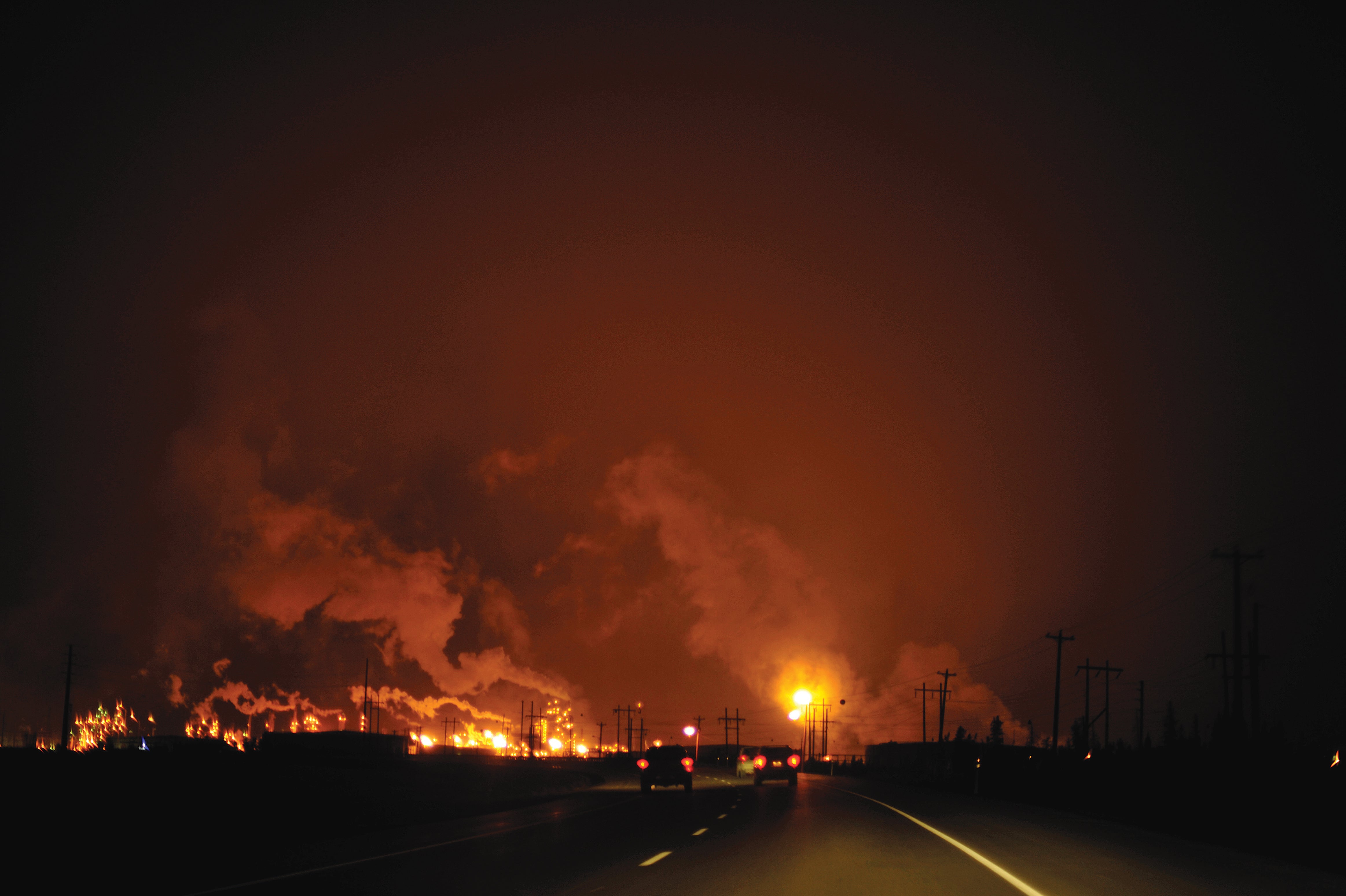
Marcel loves this remote waterscape. The nearest town, Fort Chipewyan, is disconnected by land from the rest of Canada except in the winter, when the thick ice is graded and opened to vehicular traffic. “This place—it’s everything to me,” Marcel says. “This is home.” But he also knows its isolation is deceptive: Not far upriver, oil companies are digging up immense tracts of boreal forest for the world’s largest energy project.
Below much of Alberta’s northlands lies a vast supply of bitumen, a gooey hydrocarbon product that can be industrially “upgraded” into synthetic crude oil. The bitumen comes mixed with sand or clay, and depending on its depth can be extracted by open-pit mining or by injecting steam underground and pumping up the softened product.
To many industry and political officials, these “oil sands” are the answers to the United States’ prayers: a North American source of oil that offers independence from the Middle East and other unstable nations like Venezuela. But its extraction comes at a terrible cost: the destruction of Canada’s boreal forest, which provides breeding grounds for up to three billion birds. The world’s largest intact forest also offers habitat to black bears, lynx, and great herds of caribou. And it soaks up carbon with twice the efficiency of tropical rainforests—a hedge against global warming. Downstream residents and environmentalists, who prefer the term “tar sands,” say the threat to the boreal far outweighs the benefit of this new energy source.
Flying into Fort Chipewyan this morning on a chartered Jetstream, we inspected the tar sands from above. At first we saw undisturbed forest: a pillow of aspens and poplars, broken up by snaking wetlands. Suddenly the trees gave way to a manmade, industrialized desert, streaked with black and dotted with pools of viscous bitumen. Stacked slabs of bright-yellow sulfur rose like parodies of the terraces at Machu Picchu. Lakes of toxic waste shimmered with surface oil. Even where the forest remained, it was fractured by clear-cut ribbons joined at circular nodes, like outlines of giant Tinker toys.
I’m traveling with a group of environmental leaders on a fact-finding trip organized by the U.S.-based Natural Resources Defense Council (NRDC). The visit comes as tar-sands development has started going gangbusters. Today Canadian oil accounts for 19 percent of U.S. oil imports. Roughly half comes from the tar sands, which cover an area the size of Wisconsin. By 2035 Alberta’s bitumen could provide up to 37 percent of our foreign oil needs, according to the consulting firm IHS Cambridge Energy Research Associates. The Obama administration, which has been quietly talking with environmental leaders, has not taken a firm position on the issue. In his most explicit remarks, President Obama told the Canadian Broadcasting Corporation last February that he believed technology would eventually lessen the tar sands’ “big carbon footprint.” Many environmentalists view that hope with skepticism.
Our group is touring the tar sands and meeting with industry officials and other local residents. From the oil company representatives, we hear about responsible extraction and replenishment. Those on the other side tell us about depleted and contaminated water, rare cancer, and the loss of bird and mammal habitat. They wonder aloud what will remain of their province if oil companies continue extracting northern Alberta’s resources at the projected expansion rate.
“From where we’re sitting right here, it’s 60 miles due south to the closest oil sands,” Marcel says. “In 30 years it’ll be right in my back area. And there’s not a thing I can do about it.”
A delegation from Suncor Energy meets us at the airport in Fort McMurray, the boomtown nearest Alberta’s bitumen mines. In 1967 Suncor became the first company to set up shop in the tar sands. In 2009 it merged with Petro-Canada to become the nation’s largest energy firm.
Suncor prides itself on maintaining a dialogue with critics, billing itself as a “sustainable energy company” and noting that it has reduced its water use and the amount of greenhouse gases produced per barrel of oil. But none of the visiting environmentalists expects to come away a believer. There’s a reason opponents call tar-sands fuel the world’s dirtiest oil: Extracting bitumen and purifying it into synthetic crude uses so much natural gas that it creates roughly three times the greenhouse-gas emissions as conventional North American oil production, according to a 2009 study by the U.S. Department of Energy.
“This is the highest-impact oil on a per-barrel basis,” says Alberta biologist Simon Dyer, who is accompanying the U.S. visitors today. Dyer heads the Oil Sands Program at the Pembina Institute, a respected Canadian sustainable-energy think tank. “In a time when we need to be reducing greenhouse-gas emissions, this is actually sending us in the wrong direction.” What’s more, Dyer adds, tar-sands operations suck up more water than the Athabasca River can spare during times of low water flow. “During late winter there are periods when the river is being damaged if the flow drops low enough,” he says. “Yet there is no time when companies are forced to halt water withdrawals.” What water remains is contaminated. Last December University of Alberta ecologist David Schindler published a landmark study linking the Athabasca’s high levels of cancer-causing polycyclic aromatic hydrocarbons (PAHs) and similar pollutants directly to the tar-sands operations.
Mark Shaw, a recently retired Suncor vice president, acknowledges that extraction takes its toll. “We are running an oil-sands facility that has an open-pit mine. We have an environmental impact,” he says. “Our view is that it’s an acceptable impact for the social and economic benefit.” The biggest benefit is the potential for energy independence, say the industry’s U.S. boosters, who also insist that critics exaggerate tar sands’ carbon intensity.
Mostly, Shaw wants to talk about Suncor’s effort to turn a tailings pond back into woodlands. Tailings, sludgy by-products of the mining process, have become one of the industry’s biggest vulnerabilities. The waste—which can contain metals, cancer-causing PAHs, and fish-killing naphthenic acids—is discharged into manmade holding structures and former mine pits. The resulting “ponds” attract migrating birds: Some 1,600 ducks died in 2008 after landing on a tailings pond built by the oil company Syncrude. And the waste leaks into the environment—almost three million gallons a day, according to the Pembina Institute’s crunching of industry data.
We pile onto a bus, headed for what was once the most notorious tailings pond. The driver navigates the top of Tar Island Dyke, which separates the waste from the Athabasca River, 325 feet below. Decades of data have proven this dike an imperfect barrier. A 2007 University of Waterloo report said a thousand gallons of tailings water were seeping through the structure every minute.
When we reach the pond, it looks more like a massive sandbox than an aquatic body. Caterpillar tractors shape the sand into knolls and valleys. Suncor has moved the liquid waste to a safer pit and replaced it with sand, which in turn will be covered with topsoil and planted with 40 species of native trees and shrubs, including balsam poplar, trembling aspen, jack pine, willow, Saskatoon shrub, and red-osier dogwood. “We’re converting it back to a forest,” says Sean Wells, Suncor’s manager of research engineering.
“My goal at Suncor is to be able to walk across every single tailings pond before I retire,” says Wells, who is 45. In addition to cleaning up the existing ponds, he says, Suncor is developing technologies to avoid creating liquid tailings in the first place.
This hopeful story has some caveats, though. First, the waste has not disappeared. It has been moved elsewhere, and apparently Suncor has no definitive plans for its treatment. Wells says the industry is actively developing technologies to deal with “the tailings challenge.”
Second, the reclaimed site will not look like the ecosystem Suncor found more than 40 years ago. The original system was mostly wetlands, which provide specialized habitat and help maintain water quality but are hard to re-create. The new ecosystem will be dominated by upland forest species that provide valuable timber. The reason is partly political, says Suncor’s Shaw: Alberta has a pro-business government, and “the current regime wants to create as much productive forest as possible.”
Finally, scientists question whether it would be possible to reconstruct a true functioning boreal forest—even if the oil companies wanted to. One problem: No one has yet mastered the art of reproducing these complicated ecosystems. Another: wildlife mortality and growth defects. Leah Bendell, an ecologist and geochemist at Simon Fraser University in British Columbia, has introduced mallard ducklings, fathead minnows, and immature boreal toads and wood frogs into reclaimed wetlands at Alberta tar-sands sites. The fish and amphibians had unusually high death rates, and many tadpoles suffered deformities. The ducks faced restricted growth that decreased their chances of survival.
For all of Suncor’s enthusiasm, NRDC attorney Susan Casey-Lefkowitz still finds herself a skeptic. “A lot of what the oil companies are looking at is totally destroying an ecosystem and thinking that they can start to rebuild it, in a manmade fashion, 40 or 50 years down the line,” she says. “We just don’t know enough about the complexity of these ecosystems to be able to rebuild them in a laboratory.”
Alberta’s indigenous communities are particularly concerned about the science experiment happening in their backyard. Their health, they say, is at stake. In 2006 a physician named John O’Connor discovered outsized cancer levels among the 1,200 mostly aboriginal residents of downstream Fort Chipewyan, including multiple cases of bile-duct cancer. Alberta’s government downplayed the concerns, so Fort Chipewyan’s health board hired ecologist Kevin Timoney to study water and sediment quality.
Timoney discovered dangerous and likely rising levels of arsenic, which is linked to bile-duct and other cancers, along with mercury and PAHs. (All three contaminants are present in tailings ponds.) The delta’s geology worsened the threat. “Fort Chipewyan lies within a depositional basin in which metals and other contaminants tend to accumulate in fine-textured sediments,” the ecologist wrote. They also become concentrated in fish, a key part of the local diet. During his research, Timoney talked with aboriginal elders who reported watery-tasting fish, moose with discolored livers, and fish with various deformities, like curved spines, bulging eyes, and malformed fins.
Still, applications for tar-sands expansion are pouring into the offices of Alberta’s First Nations, which lack the staff to challenge them effectively. “We’re inundated,” says Doreen Somers, who directs the industrial relations council for the Fort McMurray #468 First Nation. “It’s a wonderful system that works for them. We get tied up in that conveyor-belt paper process,” leaving no time to focus on big-picture policy making.
After a day in the tar sands—where the trees are called “overburden” and bulldozed en masse—it’s a relief to arrive at the Peace-Athabasca Delta. Joe Marcel and his siblings live in Fort Chipewyan but escape whenever possible into the delta’s roadless reaches, traveling by boat or snowmobile. Today our base camp is Moose Crossing, a waterside tract directly across from First Nations reserve land. Marcel’s sister owns the property, which has a modest solar-powered trailer and a garden bursting with beets, lettuce, and green arrow peas.
At the camp we eat moose-and-bison stew, along with a sconelike bread called bannock made from flour, oil, baking powder, and raisins. We watch song sparrows and rose-breasted grosbeaks flit amid the aspen branches. As dusk approaches, we huddle around a fire pit, peering through binoculars as beavers and buffleheads glide down Fletcher Channel. A quick storm chases us inside. When it passes, we return to find a rainbow hovering, miragelike, across the water.
Mostly we explore the boreal forest. Our hosts dock their boats at a soggy bank, then arrange some castoff planks to help us cross onto dry land. Covered in full-body mosquito netting, we hike along a trail lined with yarrow and bluebells, crunching caribou moss underfoot and grazing on Saskatoon berries. The brothers point out evidence of recent moose activity: tracks in the moss, piles of droppings, and pin cherry shrubs, which provide nutrition. Equally evident is the importance of these woods to the Athabasca Chipewyan: On a hilltop overlooking Jackfish Creek, we come to a cemetery where knee-high picket fences surround hand-lettered graves. Generations of Marcels are buried here.
This forest, say scientists, is among the world’s most important, yet it is being squandered. First we logged it for toilet paper and catalogs (see “Paper Chase,” January-February 2009), and now we are strip-mining it for the world’s dirtiest oil. This deforestation robs the ecosystem of its extraordinary ability to hold carbon—at a time when global leaders are struggling to figure out how to keep excess carbon out of the atmosphere. What’s more, tar-sands development decimates birds. In 2008 the Boreal Songbird Initiative, along with the NRDC and the Pembina Institute, looked at the ways bitumen extraction reduces bird populations, including habitat loss, water withdrawals, and pollution. At minimum, the study concluded, six million birds will be lost over 30 to 50 years. Worst case, that number could reach 166 million. Their estimate includes both living birds and an additional generation that, according to the study, “will have lost their chance to exist.”
“The more you lower the population, the more you have lost its resiliency to rebound,” says biologist Jeff Wells, the Boreal Songbird Initiative’s senior scientist. He has “grave concern” about several species of neotropical migrants that depend heavily on the boreal. The short-billed dowitcher, for example, has only three breeding areas, one of which overlaps the tar sands. Already its numbers are down at least half from a century ago. “There are historical records of single flocks of tens of thousands,” Wells says. “Now if you see 50 of them at a time, that would be big news.” Likewise, he says, the olive-sided flycatcher is drawn to clearcut areas like those found around bitumen facilities. There the birds are vulnerable to both predation and less or different food. “They’re ecological traps,” he explains.
As the shallowest reserves are depleted, oil companies will shift from strip-mining toward injecting steam underground and pumping melted bitumen to the surface. This method doesn’t scar the landscape as dramatically as mining does. But it requires a spider web of roads and natural-gas lines that will cut through the boreal wilderness, threatening to harm even more birds.
Mammals, too, face mortal danger. In a 2001 study, researchers fitted 36 woodland caribou with GPS collars. They discovered that many of the animals refused to pass within 3,300 feet of oil and gas wells or 800 feet of roads and “seismic lines” cut for geophysical exploration. The tangle of infrastructure reduced the caribou’s range by up to half and made them more susceptible to wolf predation. University of Alberta scientists calculated in 2002 that at the current rate of industrial expansion, woodland caribou could disappear from northern Alberta within 37 years. In 2008 the Canadian government announced that most of Alberta’s caribou herds are no longer capable of sustaining themselves over the long term without ongoing intensive management, such as predator control or transplanting animals from other populations.
Environmental leaders insist that, with immediate political action, the destruction of the boreal forest and its wildlife can be prevented. The Lower Athabasca Region, an area the size of Maine that encompasses virtually all the current bitumen-production area, maintains 94 percent of its biodiversity, according to the Alberta Biodiversity Monitoring Institute. This, says Pembina’s Simon Dyer, means the region could still be saved—by slowing tar-sands expansion and setting aside protected wilderness. For its part, the United States needs to implement a tough National Low-Carbon Fuel Standard. Such a nationwide policy, like California’s recently adopted Low-Carbon Fuel Standard, would encourage the production of alternative transportation fuels with lower greenhouse-gas emissions, like cellulosic ethanol, corn-based ethanol, and biodiesel, and create a disincentive for energy suppliers to use tar-sands oil. So far all attempts to introduce a national standard—including legislation proposed in 2007 by then-Illinois senator Barack Obama and Iowa senator Tom Harkin—have been ultimately shot down. Right now there is no proposal on the table, but the EPA does have the authority to implement a national fuel standard. The United States also needs to dramatically reduce its demand for fossil fuels. By 2020 Americans could save 4.4 million barrels daily—21 percent of our current total and more than the tar sands’ forecasted production—by improving vehicle fuel efficiency, enhancing public transit, developing advanced biofuels, doing smarter city planning, and retrofitting houses and office buildings with improvements like cleaner heating systems, according to the NRDC. “There is an alternative future for Alberta’s boreal forest,” says Dyer.
For Joe Marcel, fighting for that alternative future is a matter of physical and cultural survival. “I’ve traveled this whole delta all my life,” he says. “I know for sure this is where I’m going to see the last of my breath. This is where I’ll die.” Then he chuckles. “And hopefully,” he adds, “we’ll still have a little bit of green left.”