 Skip to main content


Poisons Used to Kill Rodents Have Safer Alternatives
A second generation of ultra-potent rodenticides creates a first-class crisis for people, pets, and wildlife.

Clinical assistant professor Maureen Murray of the Tufts Cummings School of Veterinary Medicine in central Massachusetts was doing a good job of keeping her emotions under wraps as she clicked through photos of her recent necropsies. But I was watching her eyes as well as her computer screen, and they revealed anguish. Like her colleagues here and at similar clinics around the country, Murray is a wildlife advocate as well as a scientist.
Each image was, in her word and my perception, “sadder” than the last. There was the great horned owl with a hematoma running the length of its left wing; the red-tailed hawk’s body cavity glistening with unclotted blood; sundry raptors with pools of blood under dissected skin; the redtail with a hematoma that had ballooned its left eye to 10 times normal size; and, “saddest of all,” the redtail with an egg. The well-developed blood vessels in her oviducts had ruptured, and she had slowly bled to death from the inside.
All these birds were victims of “second-generation anticoagulant rodenticides” used by exterminators, farmers, and homeowners. They’re found in such brand names as d-Con, Hot Shot, Generation, Talon, and Havoc, and they sell briskly because of our consuming hatred of rats and mice. The most pestiferous species are alien to the New World and therefore displace native wildlife; they contaminate our food and spread disease. We also hate them for their beady eyes, their naked tails, and their vile depictions in literature, from Aesop to E.B. White. So the general attitude among the public is “if a little poison’s good, a lot’s better.” But even a little second-generation rodenticide kills nontarget wildlife.
Both first- and second-generation rodenticides prevent blood from clotting by inhibiting vitamin K, though the second-generation products build to higher concentrations in rodents and are therefore more lethal to anything that eats them. The second generation was developed by Imperial Chemical Industries of London at the request of the World Health Organization, because rats appeared to be developing tolerance to warfarin, a first-generation rodenticide.
U.S. Fish and Wildlife Service contaminants specialist Michael Fry makes this point about the widespread use of second-generation rodenticides by people oblivious to the dangers: “One good reason for using first-generation poisons is that if you do have a problem, like developing tolerance, you want a backup. If you go in with your strongest thing first, there’s no backup.”
For a rodent to get a lethal dose from a first-generation rodenticide it has to eat it more than once, but that’s not a problem. Leave first-generation baits out for a week and they’re just as efficient as the second generation. What makes second-generation rodenticides so non-selective is that they kill slowly, so rodents keep eating them long after they’ve ingested a lethal dose. By the time they expire, or are about to, they contain many times the lethal dose and are therefore deadly to predators, scavengers, and pets.
Because they are weapons of mass destruction, second-generation rodenticides are the preferred tool wildlife managers use to restore native ecosystems to rat-infested islands. But the EPA has declared them too dangerous for public use and ordered them off the general market. They’re still widely available, however, because stores have huge stocks and because a recent court decision has allowed three of the largest manufacturers to defy the order.
Many of Murray’s patients don’t have enough red-blood cells to deliver oxygen to their tissues, so they are logy. Their heads droop, the linings of their mouths are pale; some bleed from their eyes, nose, lungs, or other organs. In 2011 she found rodenticides in 86 percent of the raptor livers she examined, and all but one contained brodifacoum, especially deadly to birds. She rehabilitates some patients by injecting them with vitamin K, but the birds still retain rodenticides and are likely to accumulate more after they are released.
There’s no safe place or safe delivery system for second-generation rodenticides. After a rodent partakes, it stumbles around for three to four days, displaying itself as an especially tempting meal not just for raptors but for mammalian predators, including red foxes, gray foxes, endangered San Joaquin kit foxes, swift foxes, coyotes, wolves, raccoons, black bears, skunks, badgers, mountain lions, bobcats, fishers, dogs, and house cats—all of which suffer lethal and sublethal secondary poisoning from eating rodents. Deer, nontarget rodents, waterfowl, waterbirds, shorebirds, songbirds, and children suffer lethal and sublethal poisoning from eating bait directly.
A four-year survey (1999 to 2003) by the Environmental Protection Agency found that at least 25,549 children under age six ingested enough rodenticide to suffer poisoning symptoms. Currently about 15,000 calls per year come in to the Centers for Disease Control from parents whose children have eaten rodenticides. Even if you place bait where children can’t get it, rodents are apt to distribute it around your house and property.
In California, the only state other than New York that has looked carefully, rodenticides showed up in 79 percent of fishers (one fisher even transferred poisons to her kit via her milk), 78 percent of mountain lions, 84 percent of San Joaquin kit foxes, and, in San Diego County, 92 percent of raptors.
In New York rodenticides were found in 49 percent of 12 species of necropsied raptors. For great horned owls the figure was 81 percent.
Similar contamination is seen around the world. In Great Britain necropsies revealed the poisons in 92 percent of red kites, 91 percent of barn owls, and 80 percent of kestrels. In Denmark rodenticides were found in 73 percent of all necropsied raptors. In just a six-week period ended on January 23, 2012, second-generation rodenticides killed about a dozen spotted eagle owls in Port Elizabeth, South Africa. Rodenticides are also blighting raptors in Australia, New Zealand, Ireland, and Canada.
Canada doesn’t have near the rodent problems we do, but raptors there carry as much rodenticide as anywhere—a fact that puzzles Pierre Mineau, a leading ecotoxicologist who retired from Environment Canada’s National Wildlife Research Centre in 2012. “There are high levels of exposure in every species we’ve looked at,” he says. “Not just in the rodent eaters but in the accipiters [which eat mostly birds]. I wouldn’t have expected that. It’s still a mystery how this stuff is moving through terrestrial food chains. Insects may be picking it up and passing it to the songbirds that eat them. That might account for the accipiter [poisoning] connection.”
While the California data is quite recent, monitoring has essentially ceased there and in New York, and it never really began anywhere else. “If you look back at the incidence reports, there are big peaks, and then the funding gets cut off by California and New York,” remarks Nancy Golden, a contaminants specialist with the U.S. Fish and Wildlife Service.
But at least in California and New York, nontarget rodenticide poisoning is a public issue. New York City is much enamored of a 22-year-old red-tailed hawk named Pale Male (“How the Nest Was Won”). In February 2012 Pale Male’s mate, Lima, was found dead shortly before she would have laid eggs. The inside of her mouth was pale, as were her heart, lungs, liver, spleen, kidneys, and brain. The necropsy turned up fatal doses of three rodenticides, including brodifacoum, in her liver. Pale Male then took another mate, his sixth—Zena. In 2012 the pair fledged three chicks, one of which is thought to have been killed by rodenticides and two of which were gravely sickened by rodenticides but treated with vitamin K and released. The city, of course, has lost many less famous birds.
New York City Audubon entreats the public never to use the two second-generation rodenticides most toxic to birds (brodifacoum and difethialone) and not to use others except as a last resort and never during nesting season, when adults can feed poisoned rodents to their young and each other. But some bird lovers are scolding the organization for not demanding a complete ban. Director Glenn Phillips offers this defense: “Our city has a huge rat problem. We can’t ban all use of rodenticides; it’s never going to happen. If we were to advocate that, we couldn’t get the support of a single city agency. If you want to tilt at windmills, you can try. If you want to actually make things better for birds, you have to do what you can to reduce rodenticides, even if you can’t eliminate them.”
I have to side with Phillips because his organization has no choice. It’s making the best of a bad situation. But that doesn’t mean second-generation rodenticides have a legitimate place in or around New York City dwellings or in or around dwellings anywhere—not even when set out by farmers or licensed exterminators. Both tend to be just as clueless about collateral poisonings as the general public.
Consider the experience of Jeannine Altmeyer, a retired opera singer from the small south-coast town of Ojai, California. She had a major rat infestation because her 2.5-acre property is surrounded by orange and avocado farms. So in 2009 she hired a licensed exterminator. “These guys came every month for three years,” she told me. “There were far fewer rats for the first two years, but last winter we had a horrible infestation. Every night I’d see at least five rats crawling on the chicken coop. The company put out these tamper-proof boxes. Then on August 3, 2012, my beautiful, five-year old golden retriever, Franz, was acting strange. His gums were snow white; back then I didn’t know what that meant. He weighed 90 pounds. We had to carry him downstairs on a sheet, and he died on the way to the vet’s. Franz was a wonderful dog. I had a necropsy done; they found brodifacoum.”
Altmeyer paused, then continued, her voice cracking. “The pest-control people told me the bait wasn’t dangerous, that there was no secondary poisoning. I used to throw the dead rats over the wall; I would never do that now. The local vets see lots of poisoned dogs because the farmers indiscriminately put the stuff out in their orchards. One woman didn’t have the money to pay for treatment for her poisoned dog so she was going to sell her washer and drier. The vet had to tell her, ‘Keep your machines; I can’t save your dog.’”
But second-generation rodenticides do have a legitimate use—ecosystem restoration on rat-infested islands. These projects are tremendously expensive, and you get only one shot, so you need weapons of mass destruction. There’s no “almost”; you kill every rat save non-pregnant ones of the same sex or you fail.As if in a ghoulish recast of The Nutcracker Suite, Norway rats had ruled aptly named Rat Island in the Aleutians since they’d disembarked from a wrecked Japanese ship in 1780. They’d eradicated songbirds, seabirds, native plants, and even the island’s original name—Hawadax. Biologists described the island as “eerily quiet.” Then in 2008 the U.S. Fish and Wildlife Service and its partners (The Nature Conservancy and Island Conservation) deployed two helicopters to saturation-bomb 6,424 acres with 46 metric tons of brodifacoum bait. Cost: $2.5 million.
There can be no better example of the deadliness of second-generation rodenticides than collateral damage on Rat Island. Found dead along with the rats were 46 bald eagles, at least 320 glaucous-winged gulls, one peregrine falcon, and 53 other birds representing 24 species. Despite the heart-breaking nontarget mortality, the project succeeded from a species perspective. Today the island (renamed Hawadax) is rat free, and native species rarely, if ever, seen are surging back—among them burrow-nesting seabirds, giant song sparrows (found only in the Aleutians), black oystercatchers, pigeon guillemots, rock sandpipers, common eiders, red-faced cormorants, and gray-crowned rosy finches.
Collateral damage on Rat Island taught the partners valuable lessons. In 2011 they took on the black rats thought to have been introduced by the U.S. Navy in World War II to Palmyra Atoll, a national wildlife refuge between Hawaii and American Samoa. Again they applied brodifacoum by helicopter. And because of an enormous population of land crabs known to eat rat bait like candy and with impunity the partners had to use far more poison than would otherwise be necessary. But they applied it when birds weren’t migrating through the area, and they captured resident birds, mostly bristle-thighed curlews, maintaining them in an aviary for two months. At a cost of $2.7 million and a few nontarget mortalities (but very few) the island is now rat free, and what had been a biological desert is exploding into a vibrant native ecosystem. Seedling pisonia trees, all but eliminated by rats, now carpet the ground. Other plants thought to have been extirpated are back. Dragonflies and crickets have reappeared. Fiddler crabs patrol the beaches in numbers biologists had never imagined possible. Now instead of a few hundred sooty tern fledglings there are thousands; similar nesting success of other seabirds is imminent.
“It’s really hard to argue against the overwhelming benefits of rodenticiding rats off seabird islands,” comments Canada’s Pierre Mineau, who has experience with these projects. “But I really question, as does your EPA, whether every homeowner needs a sledge hammer when a flyswatter will do. The companies don’t see it that way; once they have a product, they need to sell a certain volume to make it profitable. If they have to sell it only on a strictly needed basis for island rat eradication, it’s probably not worth it.”
The questioning Mineau refers to percolated within the EPA for years. Finally, in 2008, the agency declared that second-generation rodenticides brodifacoum, bromadiolone, difethialone, and difenacoum posed an “unreasonable risk” to children, pets, and wildlife, and gave manufacturers three years to cease selling directly to residential consumers—a standard procedure. But it left a gaping loophole by exempting large-quantity sales (presumably to farmers) and tamper-proof bait boxes used by exterminators. Predators, scavengers, and pets are no less poisoned if they eat rodents that consume bait from sealed boxes or bait set out by farmers.
Of the 29 rodenticide manufacturers receiving the EPA’s directive for new safety requirements, 26 complied. Among these was Bell Laboratories, honored by the Wisconsin Environmental Working Group, its home-state neighbor, for designing the specialized bait formulation for Rat Island. (Bell also designed formulations for Palmyra Island and similar successful projects on the Galápagos Islands, South Georgia Island, Channel Islands National Park off California, and Canna Island off Scotland.)
But in a nearly unprecedented move, three companies have refused. They are Spectrum Group, which, ironically, makes pet-care products along with the rat and mouse poison Hot Shot (whose active ingredient is brodifacoum, especially deadly to pets); Liphatech, which produces rodenticides Generation, Maki, and Rozol—the strictly regulated but still-registered prairie-dog poison that has killed raptors and predatory mammals, probably including endangered black-footed ferrets (see “Doggone”); and Reckitt Benckiser, the $37 billion-a-year multinational company that markets popular household products like Woolite, Lysol, French’s Mustard, and brodifacoum-laced d-Con.
In January 2011 Reckitt Benckiser, the most intransigent of the three, prevailed in its legal complaint that the EPA lacked the authority to enforce its order unless it had already canceled registration of a pesticide. That doesn’t mean the company won’t have to stop general consumer sales of its second-generation rodenticides if EPA pulls that registration, as it claims it will do. But formal cancellation proceedings can take years, and that’s what Reckitt Benckiser wants. Meanwhile, species that don’t have that kind of time will keep dying.
Currently Reckitt Benckiser is accusing the EPA of discriminating against minorities and low-income families. “They’re trying to turn this into an environmental-justice issue,” says Cynthia Palmer, who runs the American Bird Conservancy’s pesticides program. “That’s ridiculous. All the studies show that it’s actually these low-income kids who are getting poisoned. The New York Department of Health and Mental Hygiene went to EPA’s scientific advisory panel back in November 2011 and said, ‘No way, we don’t need these poisons. We support your 2008 order.’ ”
The EPA has been no less aggressive in exposing Reckitt Benckiser’s fiction. It notes that “data indicate that children in low-income families are disproportionately exposed [to rodenticides].”
Secondary poisoning is even more of a public issue in California than in New York. On July 4, 2007, Berkeley resident Dan Rubino found two dead birds in his swimming pool and called his neighbor, wildlife advocate Lisa Owens Viani. She identified them as juvenile Cooper’s hawks. Because they had sought water she suspected rodenticide poisoning—a suspicion confirmed by the University of California-Davis, which found brodifacoum in their livers.
Owens Viani then cofounded Raptors are the Solution (RATS), a national alliance of citizens, nonprofit groups, and local governments that educates consumers and municipalities about safe methods of rodent control and the dangers of second-generation poisons. “My neighbor was going to throw those birds [the two Cooper’s hawks] in the garbage can,” she says. “A lot of people don’t even know what they are. I think we’re just seeing a tiny percent of what’s happening.” (Owens Viani went on to serve as development director for Golden Gate Audubon, stepping down in November to devote her time to RATS.)
Because federal regulations supersede local action, municipalities can’t ban pesticide sales. But in California, thanks largely to RATS and the Hungry Owl Project out of San Anselmo, all of Marin County and seven cities—Albany, Richmond, Berkeley, El Cerrito, Emeryville, Belmont, and San Francisco—have passed resolutions discouraging the sale of second-generation rodenticides and urging stores to remove the products from their shelves. RATS is trying to get the California Department of Pesticide Regulation to cancel or refuse to renew registration of products containing them.
The San Francisco Department of the Environment has launched a citywide educational campaign for consumers called “Don’t Take the Bait” and has sent letters to 130 retailers asking them to voluntarily discontinue selling dangerous rodenticides. One hundred stores, including Walgreens, with 60 outlets, and Sloat Garden Centers, with 14, have made the pledge. Lowe’s and Home Depot ignored the request.
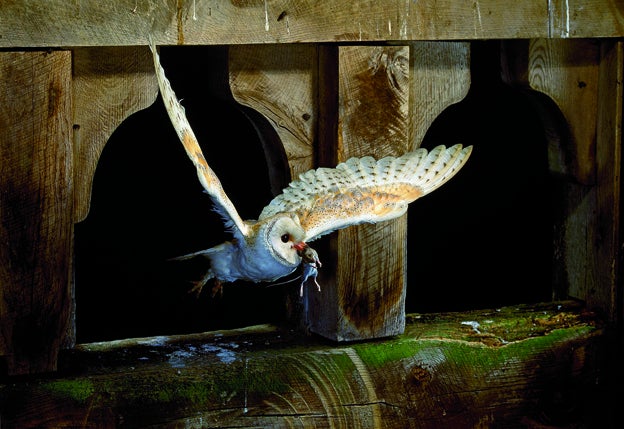
The 10-year-old Hungry Owl Project, founded and directed by former wildlife rehabber Alex Godbe, distributes safe, effective rodenticide in the form of barn owls. Once the group has prevailed on a vineyard owner to cease poisoning the gophers that gnaw grapevine roots, it erects, monitors, and maintains barn-owl nesting boxes. Currently Godbe’s outfit is working with 25 vineyards. Where gophers are causing the most damage, she recommends four to six owl boxes per 50 acres, and gets 80 percent to 90 percent occupancy.
“We work particularly with barn owls because they’re one of the few raptors that are almost nonterritorial,” says Godbe. “So if there’s enough food, you can have almost as many owls as owl boxes. And we advocate for other predators—coyotes, foxes, mountain lions, badgers, skunks, bobcats, raccoons, opossums. WildCare, a rehab facility in San Rafael and our partner organization, tests birds and mammals. I was shocked to learn that 79.1 percent of the animals it tested were positive for rodenticides. We’re killing off the natural rodent control.”
Of course, natural rodent control is not always available in heavily developed areas. Nor does it help much if rodents are multiplying inside your house. But that doesn’t mean you need weapons of mass destruction. Safe alternatives include single- and multiple-entrance snap traps, electrocuting traps, glue traps (provided you use them only indoors and frequently dispatch stuck rodents), and even first-generation baits with these active ingredients: chlorophacinone, diphacinone, diphacinone sodium salt, war-farin, and warfarin sodium salt.
Then there’s the “better mouse trap.” You take a metal rod, run it through holes drilled in the center of both lids of an emptied tin soup can so the can becomes a spinning drum. Fasten both ends of the rod to the top of a plastic bucket via drilled holes. Coat the can with peanut butter, and fill the bucket with water and a shot of liquid soap (to break the surface tension and thus facilitate quicker, more humane drowning). Mice and rats jump onto the can, and it spins them into the water. The first time I deployed the device in my New Hampshire fishing camp, it killed 37 mice between Labor Day and Thanksgiving.
Not only are these alternatives safer for people, pets and wildlife, they are, in the long run, more effective because they don’t take out the mammals and birds that keep rodents in check. With second-generation poisons you’ll get a spectacular initial kill. But a year or two later rodents will come storming back, as Jeannine Altmeyer can attest. You’ll then be fighting a war without allies.
Speak Up!
Learn more Support RATS and the Hungry Owl Project. Log on to their websites to find out what you can do to limit secondary rodenticide poisoning in your area.
Take Action Don’t buy baits containing second-generation rodenticides. And if you see them on store shelves, urge managers to remove them. If they resist, give them a photocopy of this article.
Be heard Tell the EPA to cancel general-use registration of second-generation rodenticides. Email: Wasem.Russell@epamail.epa.gov. And cite Docket ID: EPA-HQ-OPP-2011-0718.
This story originally ran in the January-February 2013 issue as "Building a Better Mousetrap."