 Skip to main content

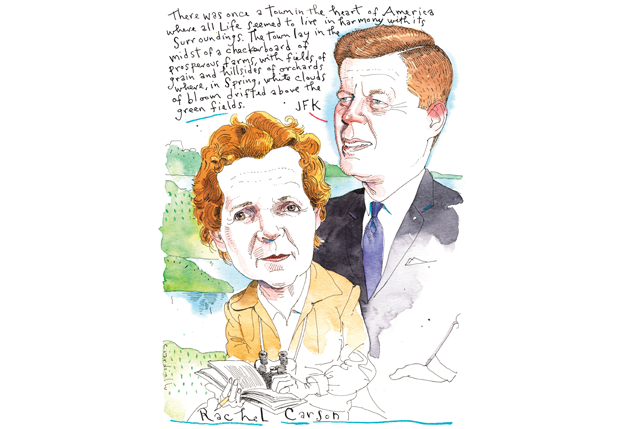

Rachel Carson and JFK, an Environmental Tag Team
On the 50th anniversary of Silent Spring’s publication, a best-selling historian shows the extent to which John Kennedy and his administration defended Rachel Carson’s controversial work against the chemical industry’s onslaught.

One of John F. Kennedy’s favorite books was Henry David Thoreau’s Cape Cod, published in 1865. When in Washington, D.C., Kennedy, a yachtsman, always craved the Cape Cod winds and turbulent Atlantic waves. He restored his health sailing the Nantucket Sound waters around sandbars and shoals. The elemental forces of the sea helped Kennedy cope with the pain of Addison’s disease and cleared his mind of the clutter of retail politics. Kennedy understood exactly what Thoreau meant when the naturalist wrote about the Cape that “a man can stand there and put all of America behind him.”
On his bookshelf in Hyannis Port, alongside Cape Cod, sat two books by Rachel Carson: The Sea Around Us and The Edge of the Sea. When it came to conservation, only marine-related issues regularly caught Kennedy’s attention. In awe of the millions of shore, sea, and marsh birds that used the Cape as a stopover during their seasonal migrations, Kennedy, a Massachusetts Audubon Society supporter, wanted to make sure that the shoreline remained unsullied by industrialization. In this spirit, on September 3, 1959, Kennedy, then a member of the U.S. Senate, cosponsored the Cape Cod National Seashore bill with his Republican colleague Leverett Saltonstall. As a longtime resident of Hyannis Port, Kennedy had no detailed knowledge of the lower Cape area, but he routinely flew over it in helicopters as the seashore legislation circulated through Congress.
Running for president in 1960, Kennedy advocated saving seashores as wildlife refuges and recreational areas. Supreme Court Justice William O. Douglas, a New Dealer and close Kennedy family friend, set the tone and tenor of JFK’s burgeoning environmentalism when he intoned at a Wilderness Conference in San Francisco that the “preservation of values which technology will destroy . . . is indeed the new frontier.”
Biologist Rachel Carson, working feverishly on her eco-manifesto Silent Spring throughout 1960, considered July 15—when Kennedy delivered his acceptance speech after winning the Democratic nomination for president and called for a “New Frontier” to reinvigorate the progressive, can-do spirit of America—a gold-starred day. Most political pundits heard only Kennedy’s vigorous lines about outfoxing the Soviet Union in the Cold War. But Kennedy—who had championed the Wilderness Bill that would eventually be signed into law by Lyndon Johnson, supported expanding bird sanctuaries and advocated the creation of new protected national seashores—offered a promise Carson found irresistible. He called for “mastery of the sky and rain, the oceans and the tides.”
Carson knew exactly what Kennedy meant by mastery: empowering biologists to help rescue America from environmental degradation. Certainly since 1945, the White House under Harry Truman and Dwight Eisenhower had been, at the most charitable, uninspiring on the conservation front, causing environmental activists to hope that another Theodore or Franklin D. Roosevelt would appear on the political horizon. Between 1945 and 1960 a string of multi-megaton thermonuclear detonations, all in the name of weapons supremacy vis-à-vis the Soviet Union, had released massive amounts of radioactive fallout in the atmosphere. During the Eisenhower era, America wasn’t just the preeminent superpower, it became the world’s leading hyper-industrial giant. This brought Americans a lot of economic lifestyle benefits. But it came at a high cost. The oceans were dying. Rainwater was unsafe to drink. “To dispose first and investigate later is an invitation to disaster,” Carson wrote around the time of Kennedy’s acceptance speech, “for once radioactive elements have been deposited at sea they are irretrievable. The mistakes that are made now are made for all time.”
Besides sounding the Paul Revere alarm about the pesticide DDT in Silent Spring, Carson also promoted nuclear non-proliferation, even dedicating the book to Albert Schweitzer, who had won the Nobel Peace Prize in 1952 for his efforts to end the atomic arms race. Carson, one of the best marine biologists alive, feared the oceans would be poisoned beyond redemption in the coming decades, and that a point of no return was fast approaching. The thought of Kennedy in the White House—a new Roosevelt—lifted her hopes that aboveground nuclear testing would be banned. (Her dream came true in August 1963, when Kennedy signed the Limited Nuclear Test Ban Treaty with the United Kingdom and the Soviet Union.)
In the spring of 1960 Carson, even while struggling with breast cancer, viral pneumonia, and ulcers, had signed up to be a New Frontier foot soldier in solidarity with the Kennedy family and Justice Douglas. Only her assistant Jeanne Davis understood how debilitating her health problems were. This was Carson’s big secret. As Linda Lear stressed in Witness to Nature, Carson had to conceal her illness, even wearing a wig when her hair started falling out during chemotherapy, for fear of the chemical companies attacking her Silent Spring research by saying, “She’s dying of cancer and wants to blame the pesticides.”
Propped up on pillows at her home in Silver Spring, Maryland, trying to heal, working away on her Silent Spring manuscript, Carson managed to find time to volunteer for Kennedy’s campaign. In the weeks leading up to Kennedy’s nomination, Carson served on the Natural Resources Committee of the Democratic Advisory Council. She hoped that in late 1962, when Silent Spring would be published, Kennedy would occupy the White House, leading a mainstream effort to slay the dual dragons of pollution: radioactive and chemical contamination of the environment. The advisory council embraced Carson’s anti-pollution ideas. Her dear friend Pare Lorentz, a film producer, wrote the council’s far-reaching report on pollution control, with input from Carson. They recommended that Kennedy, if elected, create a Bureau of Environmental Health within the U.S. Public Health Service. Carson envisioned this prototype for the Environmental Protection Agency wielding regulatory jurisdiction over “our one imperative resource: the environment in which all of us live.” Kennedy received the Lorentz report—titled “Resources for the People”—that October.
In the fall of 1960 most outdoors enthusiasts considered themselves conservationists. But Carson, using the advisory council as a bully pulpit, turned the public debate toward a new environmentalism, one properly informed of the perils of mass chemical usage. The monumentalism of Theodore Roosevelt (who protected such American wonders as the Grand Canyon and Crater Lake) and the conservation ethos of FDR (who planted trees and expanded wildlife refuges) were great accomplishments. But Carson wanted to connect the movement to public health. No longer would conservation be a cult of birdwatchers, fair-chase hunters, and outdoor recreationalists. The new ecological awareness would extend to every mom and dad striving to protect their children’s precious health. Nobody wanted to give their child cow’s milk containing dangerous levels of strontium-90 or serve fish contaminated with toxic mercury. “Ecology” became the new buzzword.
That October, while Kennedy read the council’s report, his wife, Jacqueline, invited Carson to join the Women’s Committee for New Frontiers. Not only did Carson accept, but she also met with the future first lady at the Kennedys’ Georgetown home. This wasn’t a garden club Carson was joining; it was the brain trust of the smartest women in the Democratic Party. Word spread among the liberal Washington doyennes—including Evangeline Bruce (wife of the famed diplomat David K.E. Bruce), former First Lady Eleanor Roosevelt, and former Secretary of Labor Frances Perkins—that Carson was writing about how the residue of insecticides and pesticides had been discovered in soil and water all over America. Mrs. Kennedy was pregnant with John, her baby due in December, and the mere thought that pesticides might have a genetic effect on her unborn child would have been harrowing to her.
On November 4, Kennedy beat Vice President Richard Nixon and was elected the 35th U.S. president. Carson was overjoyed. It heartened her that Kennedy, shortly before winning, issued a statement saying, “We must restore our own woodlands as a source of strength for the Nation’s future. . . . The Nation should set aside shoreline recreational refuges, and ranges must be protected to serve the purposes to which they are dedicated without interference by commercial exploitation.” Perhaps now the federal government would address her crusade against pesticides and nuclear fallout in a more pronounced, regulatory way.
For most of 1961 Carson continued slaving away on Silent Spring. She was ecstatic that Kennedy, the lover of the great Atlantic Ocean, had pushed to create new national seashores at Cape Cod (Massachusetts), Padre Island (Texas), and Point Reyes (California). In June of 1961 Elbert N. Carvel, the Democratic governor of Delaware, tried to hinder the creation of the Prime Hook National Wildlife Refuge—considered one of the preeminent stopover sites for migratory shorebirds in the fall and spring. Kennedy wrote him a threatening letter, demanding that he “retract his objections.” In 1963, under the authority of the Migratory Bird Conservation Act, the president established Prime Hook—located on the west shore of Delaware Bay—as a national wildlife refuge.
After Carson completed Silent Spring in early 1962, she once again hitched her wagon to the star of the New Frontier. With The New Yorker slated to run the first excerpt of Silent Spring in its June 16 issue, Carson went on a pre-publication alliance-building charge. She attended a White House conference on conservation convened at President Kennedy’s request. Still receiving cancer radiation treatments, Carson asked two key female allies to accompany her to the conference: Ruth Scott (a Pennsylvania conservationist and friend) and Nicki Wilson (an Interior Department publicist). “This is not an easy book to tell people about,” Carson’s editor at Houghton Mifflin had warned. “We are going to have to work up something of a crusade—on a local level—if we are to reach a really wide audience.”
Carson could have brought anybody with her to meet the Kennedys. The fact that she chose a publicist and a tireless Democratic Party networker shows how Carson was gearing up for the inevitable blowback that Silent Spring was bound to receive from the chemical industry, agribusiness behemoths, and other deep-pocketed polluters. Scott made sure that Carson interacted with Secretary of the Interior Stewart Udall and Sierra Club Director David Brower at the White House. Justice Douglas, Kennedy’s number one unofficial adviser on all things conservation, had read an advance galley of Silent Spring just before the White House conference. Carson was getting her high-powered advocacy ducks in a row. On May 27, shortly before The New Yorker excerpt ran, Paul Knight, a close adviser to Interior Secretary Udall, met with Carson to strategize on how the Kennedy administration and Carson could work in tandem to bring maximum publicity to Silent Spring.
The new frontier was now fully behind the Carson environmental zeitgeist. President Kennedy himself—after reading The New Yorker excerpt along with the first lady—wanted Carson defended from the onslaught of abuse that Big Chemical would hurl her way. The administration, in fact, was helping to publicize Carson’s work while simultaneously creating a buffer for the president if her research didn’t hold up under peer review. Justice Douglas took the New Frontiersman lead, declaring Silent Spring “the most revolutionary book since Uncle Tom’s Cabin.” Since the 1950s Douglas and Robert F. Kennedy, the president’s brother, had hiked together all over the world, from the Chesapeake & Ohio Canal in Maryland to the outback of Siberia. Justice Douglas was practically an auxiliary member of the Kennedy family. Writing in the Book-of-the-Month Club News about Silent Spring, Douglas threw down a gauntlet impossible to ignore. “This book,” he wrote, “is the most important chronicle of this century for the human race. This book is a call for immediate action and for effective control of all merchants of poison.”
What companies like American Cyanamid, Velsicol, and Monsanto would soon learn was that the Kennedy administration was setting up Big Chemical as the culprit of the planet’s worse environmental desecrations. The New York Times published its first pro-Silent Spring editorial—“Rachel Carson’s Warning”—on July 2, 1962. A few weeks later the Times ran a supportive story about Carson called “Silent Spring Is Now Noisy Summer: Pesticide Industry Up in Arms Over a New Book.” The die was cast for a king-daddy fight. At a White House news conference, which coincided with Douglas’s endorsement of Silent Spring in the Book-of-the-Month Club News, President Kennedy offered Carson his imprimatur—to a degree. While too smart a politician to embrace all of Carson’s research, Kennedy made clear that his administration took Silent Spring seriously. Because of “Miss Carson’s book,” Kennedy said in a televised press conference, the Department of Agriculture and the Public Health Service had launched a full-blown investigation into whether pesticides caused illnesses in humans. What a daring thing for Kennedy to do, the equivalent of Theodore Roosevelt embracing muckraking novelist Upton Sinclair’s The Jungle (a searing indictment of unsanitary Chicago meatpacking plants that led to the passage of the 1906 Pure Food and Drug Act). Kennedy was using Silent Spring to help push the Democratic Advisory Council’s 1960 agenda to combat pollution by connecting old-style conservation to the new-style environmentalism that called for the protection of earth, air, and water (and all creatures dwelling therein).
The day after the White House press event, Kennedy announced the establishment of a special panel of the President’s Science Advisory Committee (PSAC), headed by the highly respected Dr. Jerome B. Wiesner, to study various health and environmental questions about pesticide use. The hullabaloo over Silent Spring allowed Kennedy to go on the offensive against chemical polluters. Most other presidents would have gone into duck-and-cover mode because of Carson. But Silent Spring served Kennedy’s goal of saving wetland habitats along the Atlantic coast and having the U.S. government regulate the toxic pesticide sprays beloved by huge agricultural concerns. Although Kennedy didn’t want to be an alarmist, he didn’t mind a fellow New Frontier intellectual—like Carson—leading the gallant charge.
When Silent Spring was at last published in book form on September 27, 1962, the chemical industry went ballistic. Kennedy instantly became Public Enemy No. 1 for propping up Silent Spring as worthy of serious attention. The National Agricultural Chemicals Association rushed its propaganda booklet “Fact and Fancy” into print. The nub of the counterattack was that Mr. Fancy (a.k.a. Kennedy) was an East Coast elite who yachted frivolously around Cape Cod, his treasured national seashore, while allowing DDT manufacturers to be unjustly vilified. The association warned that factory shutdowns would mean thousands of lost jobs. When Kennedy awarded Dr. Frances Oldham Kelsey—a Food and Drug Administration scientist—a public service gold medal for discovering that thalidomide (a sedative frequently prescribed to pregnant women) caused deformities in babies, the pharmaceutical industry likewise felt blindsided. “It is all of a piece,” Carson told The New York Post, “thalidomide and pesticides—they represent our willingness to rush ahead and use something new without knowing what the results are going to be.”
In June 1962, National Audubon Society President Carl Buchheister had read a galley of Silent Spring just as The New Yorker installment was running, and decided to back Carson. Lawyers from Velsicol lobbed veiled threats at John Vosburgh (Audubon’s editor) and Charles Callison (assistant to the NAS president) over lunch, warning them to beware of associating with Carson. Big Chemical was gearing up to blast her out of the water. Bravely, Vosburgh and Callison ignored the Velsicol bullying, though they were fearful of lawsuits. Audubon published an excerpt of Silent Spring and criticized, in an editorial, Velsicol’s pesticide programs (though it didn’t entirely endorse Carson’s argument).
Furthermore, Audubon Society branches in different cities and states banded together to serve as refuges for Carson throughout the summer and fall of 1962. Fighting a kind of guerrilla war against Big Chemical, Carson spent time at the Audubon Camp in Maine and attended a book signing at the Audubon Society in Washington, D.C. Roland Clement, vice president of Audubon and a staff biologist, publicly embraced Carson’s Silent Spring research; others at the nonprofit, more timid, expressed varied doubts. In September 1963, Audubon courageously reprinted a Carson lecture about New England wildflowers as “Rachel Carson Answers Her Critics.” But National Audubon never supported a ban on DDT. Instead, the nonprofit simply gave Carson’s defense real estate in its own organ of reform.
Not that Audubon was taking much of a risk. The Great Debate over Silent Spring ended in Carson’s favor on May 15, 1963, when President Kennedy’s 46-page President’s Science Advisory Committee report—titled “Use of Pesticides”—was made public. (It might as well have been called “Rachel Carson Wins.”) Although the report wasn’t definitive concerning any human health concerns about pesticides, it did contain a bombshell recommendation to increase public education about the biological hazards of pesticides. It was as if WARNING had been stamped on every page. “Until the publication of Silent Spring by Rachel Carson, people were generally unaware of the toxicity of pesticides,” the PSAC report stated. “The Government should present this information to the public in a way that will make it aware of the dangers while recognizing the value of pesticides.”
Carson had three aims in writing Silent Spring: creating an enduring work of literature on par with The Sea Around Us; alerting the public to the health dangers of pesticides; and forcing the U.S. government to regulate the chemical industry more stringently. That May she accomplished all three goals. The wheels of Congress now started turning in her direction. Senator Abraham Ribicoff of Connecticut demanded subcommittee hearings, which started the very day after the PSAC report came out. Secretary Udall heralded Carson as a “far-sighted and alert writer [who] has awakened the Nation.” Having achieved her goals, Carson headed north to rock-ribbed Maine for the summer. With her friend Dorothy Freeman she relaxed, watching the advancing and retreating tides from an oceanfront deck. She enjoyed the diving terns, nesting parula warblers, and scavenging gulls more than ever before, though radiation treatments had ravaged her body and shrunken her frame. When summer ended, Carson headed back to Silver Spring. Awaiting her on her desk was a letter from the National Audubon Society, informing Carson that it was awarding her its highest honor for conservation achievement. More than 500 dinner guests attended the award ceremony at the Hotel Roosevelt in New York on December 3, 1963. “Conservation is a cause that has no end,” she said in her acceptance speech. “There is no point at which we will say ‘our work is finished.’ ”
President Kennedy had been killed in Dallas just 11 days earlier. Carson mourned for months. But as solace, the New Frontier regulatory attitude toward the use of pesticides and other chemicals had taken hold of the national psyche. The Kennedy-Carson vision of an America with “mastery of the sky and rain, the oceans and the tides” lived on in Lyndon Johnson’s Great Society, igniting the grassroots modern environmental movement that would bring us such landmark legislation as the Clean Air Act, the National Environmental Policy Act, and the Endangered Species Act—all signed into law by President Richard Nixon.
Suffering terribly from myriad illnesses, Carson died on April 14, 1964. In the same way Abraham Lincoln was forever tied by history to Harriet Beecher Stowe and Theodore Roosevelt to Upton Sinclair, so, too, had Carson been linked to Kennedy’s New Frontier conservation. There is no shortage of conflicting opinions about the controversial DDT analysis in Silent Spring. But no one disputes that by 1964 the environmental revolution was on, and Kennedy and Carson were among its John the Baptist figures. Their shared love of the Atlantic seaboard—particularly the migratory shorebird areas from Maine to Virginia—fused together an alliance that uplifted outdoors enthusiasts in all 50 states. “Kennedy loved marine conservation,” Udall recalled. “And Carson was his muse.”