 Skip to main content


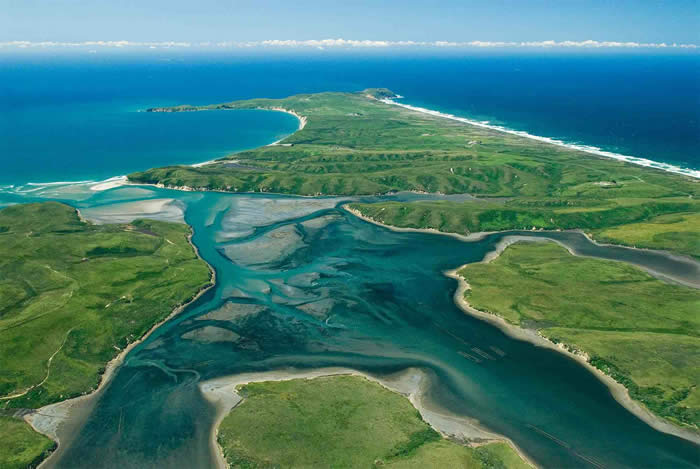

Drakes Estero is in many ways everything a federally protected wilderness area should be: pristine, vibrant, remote. Its long fingers of land reach out from California’s northern coast into the Pacific Ocean, creating a rich, tidal ecosystem. Here, harbor seals bask on the shore and thickets of eelgrass sprout from an estuary, providing food for black brant sea geese and a nursery ground for endangered steelhead and other fish.
Comprising more than 2,200 acres in Point Reyes National Seashore, Drakes Estero is so biologically important that in 1976 Congress designated it as wilderness—the highest level of federal protection. That status, however, was not to go into effect until 2012 because of conflicting land use involving long-standing oyster farming in the area. Currently, Drakes Bay Oyster Company maintains 1,000 acres within the Estero for growing shellfish. The company is attempting to extend its operations for at least another decade, which could postpone wilderness status indefinitely. The move has fueled arguments among conservationists, scientists, and oystermen who dispute the effect of commercial activity on the habitat. As a public comment period on the issue comes to a close this December 9th, the fate of the potential wilderness area is anyone’s guess.
Oystermen have farmed Drakes Estero since the 1930s. In 2005, the Lunny family bought the facilities. Aware of the property’s impending expiration date, the Lunnys maintain that their rights can—and should—be extended and have appealed to the park service and local government. “This is farming in the middle of farmland,” says Kevin Lunny, the family’s spokesman. The National Seashore includes 15 operating dairy and cattle ranches, according to the park’s website, which predate the establishment of the park. Those, however, are situated in a designated pastoral zone, whereas the Lunnys' commercial operation is not.
A rider to an appropriations bill intended to prevent the wilderness designation, crafted by Senator Dianne Feinstein of California, now places the decision about Drakes Estero in the hands of Interior Secretary Salazar. If a new use permit is granted, the Lunnys will continue operations another 10 years, with the potential for renewal and delaying the wilderness designation.
The rider has created a rift in the San Francisco Bay area’s environmental community. Many wilderness supporters believe the oyster company has been given sufficient time to cease operation. The Lunny family, however, sees its operations as compatible with nature as well as human needs. “We are a solution, not the cause of a problem,” says Kevin Lunny. His family—which donated generously to both the Native Oyster Restoration Project in San Francisco Bay and the Western Snowy Plover Recovery Project—is a big part of the the locavore and sustainable food movement, Kevin Lunny says. Drakes Bay Oyster Company claims to supply 68 percent of the Bay Area’s shellfish. Without this local, renewable source, the family argues, northern Californians would have to turn to imports. Their arguments have convinced many, including members of the Marin Conservation League, to support the new permit.
Yet, other environmentalists worry that extending the company’s land use could set a terrible precedent. The Wilderness Act is intended to set aside significant areas “where man and his own works do not dominate the landscape,” says Amy Meyer, co-chair of People for a Golden Gate National Recreation Area, who has worked for decades to protect and preserve wilderness. If the rider goes through, other parkland and wilderness across the country could stand to suffer from similar decisions, she says.
An Environmental Impact Statement drafted by the National Parks Service suggests that continuing oyster operations will do long-term damage to Drakes Estero. Oyster racks could prohibit the growth of eelgrass, according to the report, and bags on the shore block seals. Meanwhile, the oystermen’s boats disturb birds and other wildlife.
The black brant sea goose, a declining species, is among the animals that could suffer most if the estuary is damaged. Incapable of diving, this unusual little goose feeds almost exclusively on eelgrass at the water’s surface. This remarkable migrant also makes a 60-hour nonstop flight across the eastern Pacific each year, arriving on the Californian and Mexican coastline hungry and in search of its primary food source. Given that the Estero contains seven percent of California’s eelgrass, this area is crucial to the bird.
The company’s use of nonnative, potentially invasive Pacific oysters and manila clams are also a serious concern, according to Peter Brastow, conservation director of the Environmental Action Committee. “Ten more years means 10 more years of potential invasives,” he says. Already, nonnative tunicates—slimy-looking filter feeding organisms that can smother marine plant life—are spreading through Drakes Estero, Brastow says.
Some scientists, however, disagree on the impact that the oyster company has on the Estero. In 2009, a report from the National Academy of Sciences suggested that earlier park studies, which reported that the company was harming the estuary, may have misrepresented or exaggerated the negative impact (the park has since corrected certain findings). Among its comments, the Academy noted that oysters could serve the unique ecological benefit of cleaning waters. Indeed, oysters are one of the most sustainable seafoods (read "Oyster Bar"), though whether they're cleaning the Estero is unclear.
Barbara Salzman, president of Audubon’s Marin chapter, isn’t budging on the issue because she believes that Drakes Estero area was a planned wilderness area for a reason. The biologically rich region stands to lose too much to simply justify humans’ culinary palates, she says, noting that Drakes Oyster Company could move to another location on the coast. Other oyster operations, though less productive, operate within a 30-minute drive of the Estero. “There are other alternatives for the Lunnys,” Salzman says. “But there isn’t really an alternative for this area. There is no alternative for these birds, for the eelgrass, or for the seals.”*
*Factual amendments were made to this article on December 7, 2011.
A public comment period will be open until December 9. You can share your views by sending comments in support of A, the no-action alternative, which has been classified by the National Park Service as the “Environmentally Preferred Alternative." Options B, C, and D support the new permit for the Lunnys. Click here, or send comments to:
Melanie Gunn
Point Reyes National Seashore Headquarters1 Bear Valley Road
Point Reyes, CA 94956