 Skip to main content


Happy Meals
In a New York City suburb, a grand experiment in farming yields food that is grown locally on a small scale and free of toxins. The well-heeled diners flocking to the farm’s gourmet restaurant and the carefree children attending it

Even from the driveway, I can tell that this is not going to be like any other culinary experience I’ve ever had. Glossy black Simmental beef cattle toss their heads as they graze in the pasture to the right of the road; dozens of egg-laying hens are pacing up and down the ramps of their mobile chicken coops to the left. Up ahead, at the top of the hill, guests in flowing cocktail dresses and dark suits are depositing their keys with the parking valet before they head to dinner with the Rockefellers.
As the sun sinks toward the Hudson River, some of us linger inside a small courtyard garden, where it’s too tempting not to pluck a tiny Alpine strawberry. We breathe in the heady fragrances of different basil plants tucked among thick-stalked heirloom tomatoes. It’s hard not to miss the juxtaposition between the Rockefellers’ formidable Norman-style stone barn buildings on the crest of the hill, and the 22,000-square-foot, four-season glass greenhouse on the slope below, which produces leafy produce even in the coldest winter months. Beyond a brick-lined pathway leading to the restaurant, more than a dozen surprisingly clean Berkshire pigs are rooting and snorting in the brush. The pigs seem to appreciate scratches behind the ears. But not all guests seem comfortable giving a friendly pig a pet before sitting down to a meal of pork.
Yet such intimate relationships are precisely what’s at the core of the Rockefellers’ $30 million experiment—the Stone Barns Center for Food and Agriculture—which opened in the spring of 2004. “The further you are from the origins of your food,” says Dan Barber, executive chef and co-owner of the Blue Hill at Stone Barns restaurant, “the easier it is to process it, to twist it. You don’t feel connected. Food becomes just a way to fill the gas tank. But there are consequences of those choices that go far beyond your personal health.”
Part farm, part education hub, part gourmet restaurant, the Stone Barns Center occupies a cluster of stylishly renovated farm buildings on 80 rolling acres of bucolic pastures, herb-filled gardens, forests, and fields in New York’s Westchester County. Sitting adjacent to the 1,233-acre Rockefeller State Park Preserve, the center is also just down the road from John D. Rockefeller’s grand riverside home, Kykuit. The entire 4,000-acre country estate, known as Pocantico, was acquired in the early 1920s by Rockefeller’s youngest child and principal heir, John D. Rockefeller Jr., who modernized the farming operation in an effort to supplement the family’s food supply. After World War II the Rockefellers gradually stopped farming, but the property remained in the family—awaiting a new steward with an interest in agriculture. She was Peggy Rockefeller, the wife of John Jr.’s youngest son, David Rockefeller, whose lifelong passion for agriculture inspired the creation of the Stone Barns Center.
Now, 30 miles north of midtown Manhattan—in the heart of suburbia—people of all ages are discovering the virtues of supporting sustainable farming and the pleasures of eating foods grown and raised without chemicals or hormones in close proximity to where they’re consumed. Stone Barns teaches and promotes sustainable, community-based farming through three key entry points: a four-season farm that includes a farmers’ market; a for-profit restaurant that helps support the center and features seasonal, local cuisine; and public education programs for children and adults. Carrying on the culinary revolution launched by Alice Waters at Chez Panisse in Berkeley, California, more than 30 years ago, the center aims to encourage visitors to maintain food production and open spaces in their own communities, even if their first steps are as simple as supporting a local farmers’ market. “In the case of food, your dollars get transferred so perfectly into action,” Barber says. “And you can act three times a day: breakfast, lunch, and dinner.”
At the height of the growing season, roughly 80 percent of the food currently prepared at the three-year-old Blue Hill at Stone Barns restaurant (Barber’s original Blue Hill eatery is in New York City’s Greenwich Village) is grown or raised within a 200-mile radius of the center. In fact, it’s often procured from the fields and greenhouse near the restaurant’s large stainless steel kitchen. Exceptions must be made for essentials like salt, coffee, and olive oil, and for such indulgences as chickpeas from Spain. “I threw out my morals on that one,” says Barber, “but I’m constantly conflicted by it.”
With Stone Barns’ bounty at its peak near summer’s end, we’re treated to such delicacies as tiny tastes of Hudson Valley corn, pattypan squash, and heirloom tomato hearts on small skewers; new potatoes flash-fried with sage; a summer tarragon bean salad of mustardy haricots verts, Romano beans, pistachios, and tarragon vinaigrette; poached wild-caught Alaskan king salmon in a tender corn chowder laced with smoky pancetta; pork belly in a horseradish broth with diced zucchini and carrots; blackberries with a mint granité; and poached peaches with sorbet. The tastes are so sharp and so pure they leave me feeling as if I picked the produce myself and devoured it in the sun-drenched fields just outside the restaurant’s windows. “The closer you are to this stuff, the less you want to get in the way of the flavor—the more you want to let them express their lambiness, or their carrotness,” says Barber. “You need to shelve your ego. Sometimes that’s difficult, and sometimes it’s easy because you realize it’s less about you and more about the food.”
With a color palette reflecting the natural outdoor surroundings—wheat-colored walls and natural accents of wood, stone, and green plant life, from mosses to exotic orchids—the 88-seat dining room is packed each night (except Mondays and Tuesdays, when the restaurant is closed) with well-heeled patrons, sometimes including the Clintons or Martha Stewart, who live nearby. Scoring a dinner reservation requires calling two months in advance. And the food is not cheap; dinner for two ranges from $130 to $200, without drinks, which is the root of a common misconception about Stone Barns—that it’s only “for rich people,” as one local farmer recently told me. But a small café provides a selection of panini sandwiches, salads, and seasonal soups made from the same farm-fresh ingredients. The average price of $10 makes the café a much less expensive option for those on a tighter budget—or in need of an afternoon snack. And the center’s classes, which range from free to about $25, cover everything from composting and growing perfect tomatoes to crop rotation and inoculating logs with shiitake mushroom spores.
These days buying local produce in the suburbs is a tall order. Westchester County, for example, is what those in farming circles often refer to as a “food desert,” owing to the lack of agriculture. Yet, like many other counties ringing America’s oldest municipalities, this affluent area once nourished its mother city. In fact, in the early 1920s, when John D. Rockefeller Jr. took over Pocantico and commissioned the renowned architect Grosvenor Atterbury to design a complex of stone farm buildings reminiscent of the French countryside, the county contained more than 1,500 farms. Within the next decade the number dropped to 428, and it stands at 125 today, including Stone Barns. “Rapidly many of the farms were being taken over for residential purposes and for other commercial purposes,” recalls David, now the 91-year-old family patriarch.
Grandfatherly and gregarious in a checked jacket, Rockefeller sits down with me for a rare interview one rainy morning near the entryway of the restaurant—formerly the cow barn. A good sense of humor and his grasp of science, farming, and economics remain firm. His eyes sparkle as he reminisces about the woman who stole his heart, and savors his boyhood memories of the farm. “When I was a child these buildings were much simpler wooden structures where the milking cows were kept,” he says. “I would come to watch, and take a drink of the nice warm milk out of the lid of a can.”
In time hand milking was replaced by machines, and the farm gained a new farmer: David’s wife, Peggy, who raised Simmental beef cattle on this property in the mid-1970s. She was also one of the founders of the American Farmland Trust. But since her death in 1996, Peggy Rockefeller is perhaps most often remembered here at Stone Barns for her skill and vigor behind the steering wheel of a combine. “My daughter, Peggy Dulany, and I decided the best way to celebrate Peggy’s life and passion was to create a center where the threats to farmland and our food supply could be discussed, and ways to improve farming methods and agricultural policy could be explored,” says Rockefeller.
The American Farmland Trust estimates 1.2 million acres of cropland, pastureland, and rangeland are lost each year to development. Farms are increasingly being swallowed up by new houses, roads, and strip malls—86 percent of U.S. fruits and vegetables and 63 percent of dairy products currently come from areas in the path of urban sprawl. This loss of farmland combined with the shift during the past century toward industrialized agriculture has greatly extended the distance produce and meats travel. The average American meal today journeys more than 1,500 miles from where it’s grown or raised to where it’s bought—at a big cost. Green-house gases emitted during food transport contribute to climate change. Our produce is not as fresh as it would be if it were grown closer, which would improve its taste and, health experts say, possibly its nutritional value. And because our food is so heavily mass-produced and transported, the origins of outbreaks of E. coli, like those from last year’s much-reported batch of tainted spinach, cannot always be pinpointed in time to prevent human illness, sometimes even death.
Meanwhile, the majority of U.S. farmland still intact represents mostly large-scale, conventional agriculture favored by government; more than 90 percent of all subsidies are paid to the growers of just five crops: wheat, cotton, corn, soybeans, and rice. Studies show such monocultures invite pests and deplete the soil, requiring more insecticides, herbicides, and fertilizers that pollute rivers, lakes, and streams and cause declines in biodiversity. The U.S. Fish and Wildlife Service estimates that each year approximately 672 million birds are directly exposed to pesticides on farmlands in the United States, and that about 10 percent—67 million birds—die on the spot.
By contrast, produce grown at Stone Barns is free of chemical pesticides, fertilizers, and herbicides—and then some. The only soil improvements are compost made from humus-rich manure, minerals, and organic material. Crops are grown year-round, even in winter, using minimal heat in addition to what the sun provides, and intensively rotated to preserve the soil and lock in nutrients. Even in January and February up to 35 different types of hardy winter crops, including little-known varieties like claytonia (a succulent, small-leaved green rich in vitamin C) and skirret (a delicate, aromatic white root vegetable) are growing in the greenhouse.
Raised on pasture that’s kept healthy and productive, and also through rotational grazing, the center’s livestock is managed in the same environmentally sensitive fashion. The benefits are healthy for consumers, too: Grass-fed animals are often touted for being lower in cholesterol and saturated fat than their feedlot counterparts, and higher in omega-3 fatty acids and monounsaturated fats—the “good fats” that protect against heart disease. “We’re beyond organic—we’re ecological,” says Barber. “You can’t have healthy vegetables without healthy animals and birds in your ecosystem. It wouldn’t be right to say I don’t care about birds, but I really care about tasty tomatoes. The health of everything around you is important.”
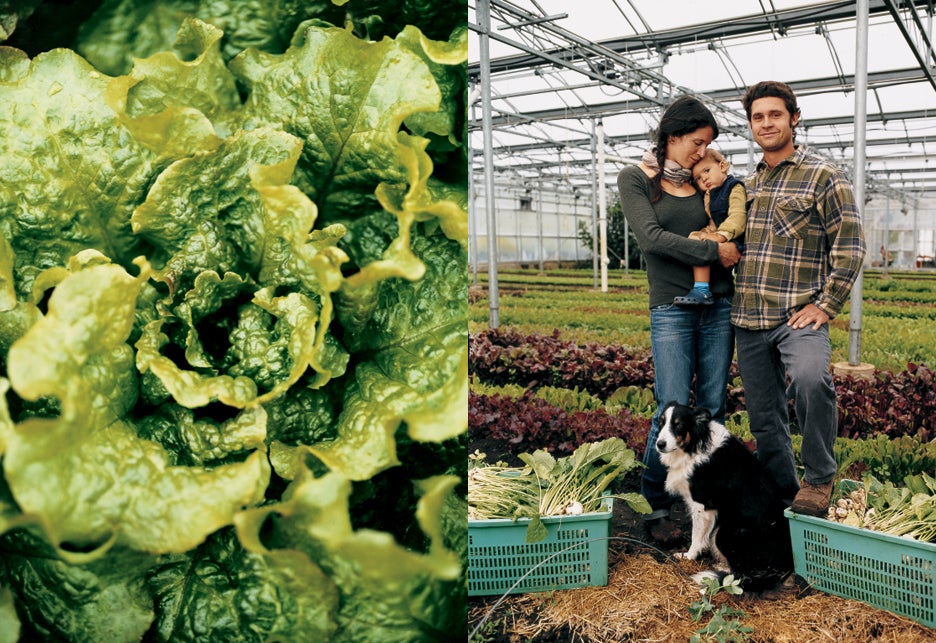
The farmers in charge of the healthy produce at Stone Barns are four-season grower Jack Algiere and his wife, Shannon, who manages the greenhouse—often with their toddler son, Sedge, in tow. Barely 30 years old, Jack and Shannon have farmed their way across the country, from Connecticut to Colorado to California and back again, frequently working part-time jobs to make ends meet in the off-season. Both have agrarian pedigrees. Jack, who recently traded in a shaggy beard for a fresh-shaven look that reveals a handsome face, is from a long line of naturalists. He spent his formative years on his parents’ organic farm in Rhode Island, and learned to drive a tractor before he turned eight. His college degree is in plant science from the University of Rhode Island. Shannon, a tall, sinuous woman who often wears her dark hair tied back in a knot as she works, attended the same high school as Jack, but they didn’t start dating until they met again in college. Her grandparents raised oats, but her mother became a teacher and her father a machinist.
Some of the farms where Jack and Shannon worked along their way to Stone Barns struggled to stay afloat. Cultivation shut down completely when a golf course moved in next door to the mail-order herb farm in Wyoming, Rhode Island, where Jack was managing the perennial and annual herb crops. “It’s so important that communities support what’s in their neighborhood,” Jack says. “There’s no way to put a value on this.”
At Stone Barns, the produce sold at the farmers’ market disappears almost as quickly as it’s set out on tables. “It’s fulfilling for us as farmers to do what we love, and get a paycheck,” says Shannon. “And we’re not just farming anymore, we’re teaching and learning.”
Taking a break from seeding radishes one afternoon, Jack, wearing his broad straw hat, sits cross-legged beneath the cool shade of a tree overlooking fields brimming with ripened tomatoes, corn, and beans. Most of the work on three acres of field crops and in the greenhouse is done by hand, he explains, using old-fashioned muscle and equipment, like long-handled seeders. In addition to preventing backaches, such hand tools spare the need for gas-guzzling, pollution-spewing tractors. “Nature has a very strong, even flow that doesn’t require a new method if you’re riding that wave properly,” he says.
He also points to a potential benefit that might come from reaching an audience in the suburbs—where half of the country’s population currently resides, according to the most recent U.S. census. Perhaps, he muses, certain homeowners might be persuaded that paying thousands of dollars for landscaping is a waste when they could instead employ a part-time farmer to grow produce on their properties, and share the harvest with their communities. A few homeowners have shown some interest in the idea. “There’s not going to be any reversion of this land,” Jack says. “But it’s still good farmable land—it just has a house on it.”
As farmlands disappeared and chemical use escalated in Westchester County after World War II, David Rockefeller witnessed one probable result at Pocantico. “During and after the war, I used to collect beetles by putting a sheet on a wall at night and a light in front of it,” he says. “In those days, on a warm night in summertime, that sheet would be black with insects. Today, doing the same thing, there would be almost nothing.”
When he was a 10-year-old attending a summer camp in Maine, Rockefeller began his beetle collection; it now contains roughly 9,000 species and more than 150,000 specimens from around the world—one of the largest private collections anywhere. “We’d go to bogs and all kinds of different places with nets, and we’d collect insects,” says Rockefeller. “I got intrigued by it. I have to say that although my principal activity as a grownup was banking rather than beetles, my ongoing interest has enriched my life.”
Rockefeller wants youngsters visiting Stone Barns to develop their own lifelong appreciation for nature and farming. More than 10,000 schoolchildren have visited the center since it opened, and close to 2,000 more have participated in public, after-school, and scout programs, and in summer farm camps.
One August morning I join a group of 10-, 11-, and 12-year-old campers receiving a lesson in the greenhouse on how to pick lettuce. “Hold the plant here,” says Shannon, gripping it at the base with one hand, “and pluck off the leaves with your other hand.” She directs each group of children to fill a metal bowl with the tender leaves and encourages the kids to sample the flavors as they do. “It’s safe to eat them without washing,” she adds. “We don’t use chemicals here.”
Ten-year-old Snowden Jones, his T-shirt damp from a pass under the greenhouse sprinklers, gets straight to work on the arugula. Pushing a leaf into his mouth and chewing, he declares, “Oh my God, it tastes like buffalo wings—really.” Like the flock of heritage turkeys foraging in the forest outside, more kids move in to pick off the leaves of this peppery lettuce, a member of the mustard family. Their eyes bulge as the spicy zing hits their tongues.
A short time later the campers don freshly pressed white chef’s aprons and march single file into the large kitchen, where giant stockpots are bubbling and a small army of chefs are dicing, spooning, and stirring preparations for the evening’s dinner service. Around a stainless steel counter, a handful of the kids create masterpieces for their enjoyment, wiggling their dough-coated fingers in a crumbly mixture of flour, sugar, and butter that will top off tins filled with plump, fresh blueberries. On the other side of the kitchen, the second half of the group takes turns folding the corners of diamond-shaped pastry dough over piles of cooked squash, eggplant, sun-dried tomatoes, basil, and carrots held together with ricotta cheese.
Afterward they head into the dining room to taste the vegetable pastries they prepared along with the salads made from the greens they plucked from the ground only two hours ago. “It’s amazing that something this healthy tastes so delicious,” says Isabel Grieder, 10, wiping her mouth with her cloth napkin ever so politely before she asks me to please write down the recipe for her—so she can make the meal for her parents as soon as she gets home.
This place is so much more than a classroom, a restaurant, or a farm; it represents a lifestyle that suffuses the taste buds with food’s joyous possibilities. In my warm blueberry crumble dessert I can taste a hint of the future: a place where all the food is fresh and free of polluting toxins, where small-scale farming is a viable way to make a good living, and where supporting it is the means to a happy and healthy life. “What’s promising about Stone Barns,” says Barber, “is it takes these issues that can often seem frustrating—because it sounds like your mother telling you what to eat—and it reframes it and roots it in pleasure. You can enter from the dining room table, or from the farm. Any way you experience it, the whole point is pleasure.”