 Skip to main content



Everglades Pythons Exhibit New Behaviors
Despite new regulations, snakes in Florida continue to cause destruction.
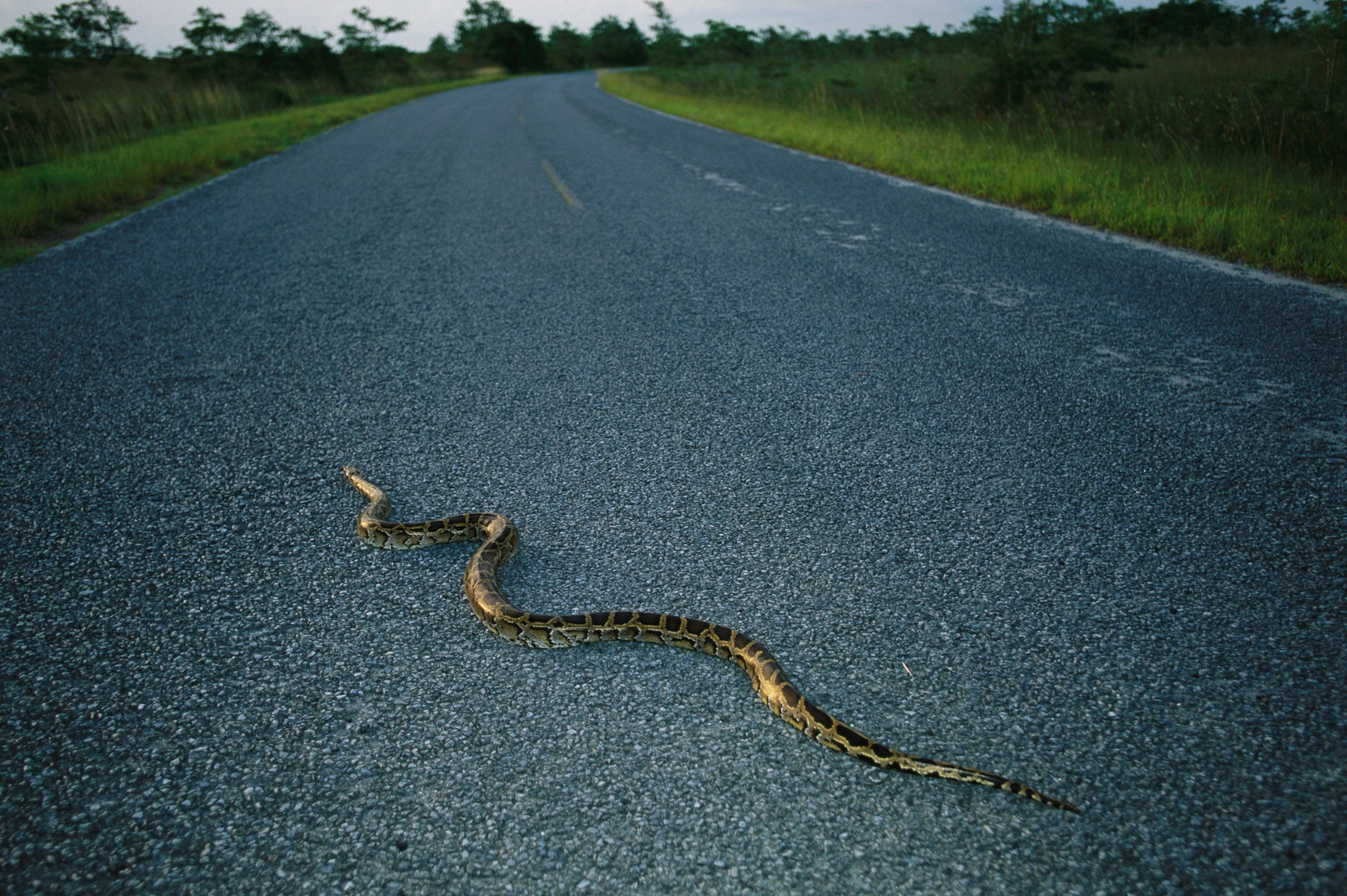
Exotic snakes are regular visitors to Laura’s farm, a mere 500 yards from the edge of Everglades National Park. Last summer, when she called Miami-Dade county rescue service to report an eight-foot python, however, she didn’t realize she was contributing to a scientific discovery. The snake on her property would reveal to biologists a totally new behavior in the invasive snakes wreaking havoc in the Everglades ecosystem.
A response team arrived and guided the snake—a Burmese python—into a sack. The team brought it to Miami-Dade Fire Rescue, but along the way, the python, jostled during transport, regurgitated a whole guinea hen and 10 intact eggs.
“Not only are these snakes eating bird young—something our native snakes do—but they might also threaten adults, which most native snakes do not because of the birds’ sizes,” says Everglades National Park wildlife biologist Skip Snow, who examined the snake at the lab. “And now eggs.”
The story will appear in a note to be published in the journal IRCF Reptiles and Amphibians. It’s one of three instances described by Snow and his co-authors of a Burmese python eating birds’ eggs, and it marks the first time scientists have ever documented the behavior. The discovery may mean that this invasive species is causing more damage to Everglades birdlife than previously imagined.
“We thought these snakes would sit and wait for prey to come by,” say note lead author Carla Dove of the Smithsonian Institution Natural History Building Division of Birds. “But maybe they’re roaming around and eating everything in their way.”
Not only is egg eating unheard of in the species, the snake’s anatomy makes it a particular challenge. The Burmese python is not equipped with the sharp toothlike projections in its throat that allow other snakes to crack open eggshells, meaning the python has to digest the eggs with shells intact.
In March, Dove and Snow, along with the University of Florida’s Michael Rochford and Frank Mazzotti, published a study showing which bird species pythons prey upon. By opening the digestive tracts of 85 pythons collected in Everglades National Park between 2003 and 2008, they discovered that the snakes consume at least 25 species, including the endangered wood stork and the snowy egret.
Based on these kinds of studies, birds make up about a quarter of the Burmese python’s diet. The bulk of its prey—some 75 percent—is mammals, and one percent is comprised of American alligators, the snake’s only known reptilian prey. Nonetheless, many questions remain.
“We really don’t know yet what the impact is,” says Mazzotti, who recently contributed to a study linking steep mammal declines in the Everglades to an increase in the python population. “But the impact on birds is particularly difficult to study.”
Mazzotti and his colleagues are trying to decipher that now. Using cameras, they’re monitoring wading bird habitats to see what happens when pythons strike. Rails and marsh birds appear to be particularly common prey, probably because pythons are opportunistic predators and their habitat and behavior overlaps with those of these birds.
Understanding how pythons affect Everglades wildlife is only half the battle; managing this invasive species is the other. Although massive—up to 25 feet long in captivity—the snake is elusive, virtually invisible amid the millions of acres of Everglades vegetation. From 2007 to 2011 the park service removed more than 1,400 pythons. But the snakes are quick to adapt to new habitats, consume any prey available, and lay large clutches. The first Burmese python was spotted on the boarder of the Everglades National Park in 1979; today tens of thousands of Burmese pythons may live there, most of them born in the park’s sawgrass marshes, swamps, and forests.
The snakes are also strong swimmers, comfortable near human habitation, tolerant of a range of salinity, and able to adapt to climates cooler than South Florida. So far they have moved into the Florida Keys, but some biologists say they could easily thrive across the southern third of the United States—and that range that could be extended depending on the future effects of climate change. In January, in part because of these predictions, Interior Secretary Salazar announced a ban on the importation and cross-state transportation of four snake species—including Burmese pythons, northern and southern African pythons, and the yellow anaconda—that threaten the Glades*.
Critics fear the ban is too little, too late. Environmental lawyer Jane Graham, who is now an Everglades Policy Associate for Audubon of Florida, previously published a survey of existing laws to prevent the influx of invasive species. Finding these laws lacking, Graham made proposals modeled on systems from around the world. She advocates stronger risk assessment, screening measures, and allowing entry to preapproved species only.
“What Americans need to do is turn their attention to invasives as homeland security issues and something that has obscene costs to the taxpayer and the environment,” Graham says. Each year invasive species cause $120 billion in damage in the United States (PDF). Since 2005, state and federal agencies, along with other organizations, have spent $6 million responding to invasive constrictor snakes in the Everglades and more than $101 million on the recovery of the wood stork, which is just one of the endangered species pythons prey upon. By allowing potential invasive species into the region, we stand to lose hundreds of millions of dollars already invested in the Everglades ecosystem.
Graham has a potential solution for the aliens: Create economic incentives for their removal, a method used with moderate success to eradicate other invasive species like the nutria, a rodent plaguing the Gulf States.
In its native Southeast Asia, the Burmese python, captured in large numbers for the pet and leather trade, is a threatened species. Ironically, the practice that has driven their numbers down has also brought them, as pets, to a new range where they are growing stronger every day. Human management, says Graham, can continue to shape the python’s fate and, with it, the fate of the surrounding ecosystem.
*The article originally stated that the boa constrictor was also part of the ban. The text has been corrected.